
IL SUONO DEL COLORE, IL COLORE DEL SUONO
La sua è la pittura della percezione, quella capacità del nostro essere di ricercare il rapporto ideale fra noi stessi e la natura, attraverso l’attività dei nostri sensi.
È così che le opere di Shuhei Matsuyama ci sollecitano, più inconsapevolmente che conscia-mente, alla visione “calibrata”, alla ricerca oltre il colore e la forma, dell’essenza stessa della composizione, la “vita” che c’è dentro. E che cos’è la vita se non immagini, suoni, aromi, profumi, movimento? Ecco dunque che l’interpretazione dei colori, delle forme, della ragione dei quadri dell’artista giapponese necessita dell’attivazione dei nostri sensi, il mettere in movimento il nostro essere alla ricerca del tracciato esplicativo. In fondo, il fascino dell’astrattismo di Matsuyama sta nel vederci ciò che ci si vuoi vedere in base alla propria sensibilità, alla nostra predisposizione ed al nostro intuito, lì quarantenne pittore nipponico, milanese d’adozione, è consapevole di ciò ed evita di lasciare segni che possano indurre l’osservatore alla percezione della conclusione dèl quadro che, al contrario, rimane aperto, vivo, epperciò mutevole, proprio come le nostre percezioni.
Non a caso le mostre del maestro Matsuyama sono accompagnate dalla trasmissione di suoni (musiche che altri artisti scrivono ispirandosi ai suoi quadri, ma che, d’altro canto, il pittore produce a sua volta ispirandosi anche a quei suoni) o dall’emanazione di profumi ed aromi da lui stesso composti.
Occorre vivere, sembra essere il pensiero di Matsuyama, il rapporto col presente con la consapevolezza del passato, poiché nulla èstatico e tutto si trasforma in un continuo moto, del suono, appunto, piuttosto che delle essenze o del tempo. I suoi quadri tendono a ram presentare, come giustamente propone Enzo De Martino, “visivamente le molteplici significazioni del (suono) che l’ideogramma (Shin-on) ha nella scrittura e nella cultura giapponese”:
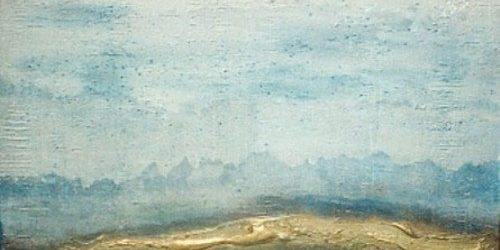
ed ecco scaturire dalla tavolozza di Matsuyama opere dal significato intenso come “lì Suono del cuore”, “lì Suono nuovo”, “li Suono vero”, “lì Suono che cresce”, “lì Suono discreto”, “lì Suono del bosco”, “lì Suono fluttuante”, “lì Suono che avanza”, tutte evocanti dinamiche, seppure quiete e discrete, trasformazioni, sia la partecipazione attiva dell’osservatore-uditore per la captazione ditali mutevoli suggestioni. Per fare ciò Shuhei Matsuyama non esita a servirsi di stucchi, gessi, colore e carta giapponese che grazie alla sua fibra particolare, una volta sovrapposta alla superficie già trattata, ascia ora filtrare attraverso le sue maglie, ora catturare e comprimere sotto la sua consistenza, entità di materiale e colore producendo effetti cromaticamente ed esteticamente piacevoli. Dato questo sapiente utilizzo della carta di riso, essa può essere a buon titolo considerata non solo alla stregua del colore, ovvero materia prima per la produzione dell’opera, ma anche elemento essenziale per la rivelazione dell’immagine conclusiva, evidenziando in tale veste il secolare uso tutto nipponico di attribuire alla materia simboli e simbolismi collegati allo spirito ed al nostro io più recondito. L’effetto, dicevo, è nella globalità assai gradevole anche perché le difformi quantità di colore e materiali e la differente sovrapposizione creano effetti di penetrazione o di agglomerazione -scanalature e rilievi – che offrono una varietà estesa di tonalità a seconda dell’intensità e della natura della luce che colpisce il quadro.
di Silvia A. Ippoliti
THE SOUND OF COLOR, THE COLOR OF SOUND
It is painting of perception, the capacity of our being to search for the ideal rapport between ourselves and nature through our senses.
This is how the works of Shuhei Matsuyama rouse us, more unconsciously than consciously, toward a “calibrated” vision, a search beyond color and form to the essence of the composition, the “life” that is within it. And what is life, if not images, sounds, aromas, smells, movement? It is here that the interpretation of the colors, forms, reasons for the paintings by the Japanese artist requires an activation of our senses, a putting into movement our beings in search for the explanatory gesture. Essentially, the fascination of Matsuyama’s abstracts lies in seeing that which you want to see, based on your own sensitivities, your predispositions and intuition. The forty-something Japanese painter (Milanese by adoption) is aware of this and avoids leaving marks which could induce the observer to a perception of conclusion in the painting which, on the contrary, remains open, alive, and thus changeable, precisely like our perceptions.
It is not just chance that exhibitions of maestro Matsuyama’s works are accompanied by sounds (music written by other artists and inspired by the paintings, but also the painter is inspired by the sounds) or by perfumes or aromas composed by Matsuyama.
Matsuyama’s belief seems to be to live: the rapport with the present along with the awareness of the past because nothing is static and everything is transformed through constant movement, in fact of sound, rather than of essence or time. His pieces tend to represent, as correctly proposed by Enzo De Martino, “visibly the multiple meanings of [sound] that the ideogram (Shin-On) has in Japanese writing and culture”.
From Matsuyama’s palette works with intense meaning spring forth: “the sound of the heart”, “the new sound”, “the true sound”, “the sound which grows”, “the discreet sound”, “the sound of the woods”, “the fluctuating sound”, “the sound which advances”. All dynamic evocations, although calm and discreet transformations for the active participation of the observer-listener to grasp certain changeable mutations. In order to do this, Shuhei Matsuyama does not hesitate to use plaster, chalk, color and Japanese paper. Thanks to the particular fiber of this latter, once placed over treated surfaces, it now permits to filter through its texture, and now it captures and compresses beneath its weight the material and color, producing aesthetically pleasant chromatic effects. Given this knowledgeable use of rice paper, it can be considered not only simply the color, or raw material for the production of the work, but also an essential element for the revelation of the final image. In this way, it highlights its centuries-old Japanese use of attributing symbols to the material and symbolism connected to the spirit and to our most hidden self. The effect is, as I said, in its entirety, quite pleasant also because the unusual quantity of color and materials and different overlapping create effects of penetration or agglomeration – troughs and ridges – which offer a wide variety of tonalities depending on the intensity and nature of the light which falls on the painting.
by Silvia A. Ippoliti