
PER SHUHEI MATSUYAMA
C’era una volta… un bambino di quattro anni, che fu accompagnato a trascorrere qualche giorno dalla nonna materna. Non era la prima volta, ma per la prima volta ciò accadeva d’inverno. La casa della nonna, che sorgeva ai piedi d’alcune collinette, secondo il bambino era grande, con un’entrata e un’uscita. L’entrata era quella cui si giungeva dalla strada, attraversando un cortile; l’uscita, sul lato opposto, immetteva in un giardino, circondato da un muretto sovrastato da una rete metallica. Su un lato, un cancello s’apriva sulla stradina sterrata che portava in collina. Il bambino fu molto stupito di non trovare fiori, in giardino, in particolare i gigli che aveva tanto ammirato nella visita precedente. Ottenute le spiegazioni richieste, commentò: “Ah, ecco, anche i fiori stanno dormendo nelle loro tane, come gli orsi”.
Il mattino successivo, una gran sorpresa lo attendeva: era nevicato! Durante la notte era caduta molta neve, tanto asciutta da formare granelli simili a chicchi di riso. Quando s’affacciò in giardino, dove nessuno ancora aveva messo piede, rimase incantato. Proprio in quel momento, anche il sole tentò d’affacciarsi tra le nubi alte, e tutto prese a scintillare. “Sembra d’essere in una grande scatola rivestita d’ovatta.” Anche i suoni giungevano ovattati. Alcuni erano del tutto nuovi: la neve cantava sotto i passi, e frusciava, cadendo dai rami smossi, con un sussurro che sembrava un messaggio dolce e misterioso. Il bambino si chiese se la “grande magia” continuasse anche fuori dal giardino, e si diresse al cancelletto. Sì, la neve era anche fuori, seppure non altrettanto intatta.
Ma sul cancello l’attendeva un’altra meraviglia: una sorta di diadema vi scintillava, qualcosa di simile ad una grande spilla di brillanti. Era una ragnatela coperta di brina, i cui luccichii emanavano bagliori iridescenti. Il bambino contemplò a lungo la perfetta geometria di quella struttura adamantina, e scoprì che essa non era formata da cerchi concentrici, come gli era parso dapprima: a partire dal centro, con la regolarità di un ritmo musicale, ogni tratto s’estendeva impercettibilmente, senza interruzioni, a costruire una figura che in seguito avrebbe appreso denominarsi spirale. La guardò stagliata contro il cielo, e gli parve estendersi fino ad abbracciarlo, mentre i suoi minuscoli luccichii diventavano il firmamento. Provò un senso di vertigine. Lo rivisse una ventina d’anni più tardi, imbattendosi in due frasi che lo colpirono. La prima affermava: “Il microcosmo riflette il macrocosmo”. Compariva a commento di un’altra frase, più sibillina: “Ciò che è in alto è come ciò che è in basso, e ciò che è in basso è come ciò che è in alto”, suggerendo un parallelo tra l’infinitamente grande e l’infinitamente piccolo. Con un brivido, l’ex-bambino considerò come la struttura del sistema solare non fosse poi dissimile da quella di un atomo. La seconda ricordava “la silenziosa armonia delle sfere”, richiamando il senso di musicalità che pervade l’intero universo e che si può ritrovare ascoltando talvolta il silenzio dentro di sé, com’egli da poco aveva imparato a fare: un silenzio vibrante, a sorpresa in grado di fornire sensazioni e risposte insperate. Si ricordò anche d’aver letto che “il silenzio è la voce di Dio”, e che per Marguerite Yourcenar “la musica dovrebbe essere solo lo straripare di un grande silenzio”.
Passarono altri trent’anni, ed un giorno tutte le emozioni, immagini e sensazioni vissute in quel mattino di mezzo secolo prima, gli si ripresentarono nette, mentre visitava una mostra d’arte. Erano esposti lavori in prevalenza di medio e piccolo formato: frammenti di preziose veline impalpabili, con tracce infinitesimali di colore emergenti dall’interno, disposte con sapienza a strati su spessi fogli di carta a mano, nella purezza ascetica del loro candore e nel loro sottile gioco di trasparenze, sembravano restituirlo al lontano stupore infantile.
Quel ciclo d’opere, e quindi anche la mostra, recava un titolo ed un sottotitolo. Quest’ultimo era: “Il suono della neve che cade”, mentre l’altro suonava “Shin-on Micromondo”.
N’era autore un giovane artista giapponese, Shuhei Matsuyama. L’ex-bambino rivisse quella lontana magia, l’intuizione che una ragnatela possa diventare il firmamento, e che il suono profondo e penetrante del silenzio possa far vibrare ogni fibra del sé, in sintonia con l’universo intero.
Shuei Matsuyama lavora ormai da oltre un decennio a cicli d’opere sullo Shin-on, vale a dire sui suoni. Questa, la traduzione letterale. Solo che si tratta di suoni interiori, espressioni del Ki, inteso come il respiro dell’universo, l’energia cosmica di cui ognuno di noi è emanazione e cui ci si deve rapportare, in armonia. “Il mio supplizio è quando / non mi sento in armonia”. Armonia in sé, armonia con gli altri, armonia con il Tutto. La sua assenza è un supplizio.
C’è un ulteriore particolare: Shin-on, in giapponese si può scrivere in sedici modi differenti, omofoni, dando vita ad altrettanti significati diversi, ognuno dei quali è compresente agli altri. Se ne può privilegiare un aspetto, se ne possono accostare tra loro alcuni, ma anche gli altri vengono sempre evocati, simultaneamente. E tutti richiamano l’idea di un sentire spirituale che fa da ponte tra la propria interiorità e il Tutto.
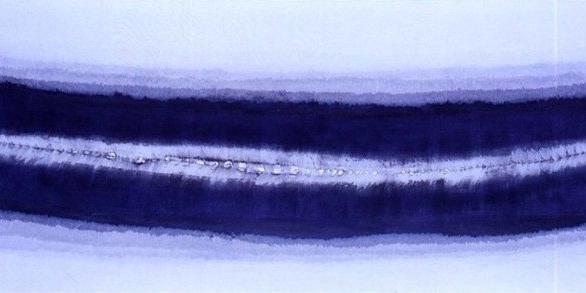
La parola spiritualità è pertinente: il misticismo ascetico di Matsuyama non è di natura religiosa, riconducibile ad una confessione specifica o a delle pratiche devozionali. E’ spiritualità, intensa, vissuta, onnipervasiva. Emerge netta anche dal parco impiego d’archetipi che compaiono nei dipinti, senza indugio alcuno. Spesso ricorre una linea orizzontale. In taluni dipinti richiama l’idea di un remoto orizzonte di paesaggio, ma si tratta di paesaggi e d’orizzonti dell’anima che aspira all’infinito. Più spesso la linea è mossa, contorta, ad indicare una continuità, il fluire del tempo, il divenire: del singolo, della storia, delle civiltà, con i loro nodi, il loro ritornare su di sé, per poi riprendere a scorrere, di nuovo verso l’infinito. In talune opere, più raramente, la linea è verticale, ad esprimere forza, la perentorietà di certe scelte, del “destino che bussa alla nostra porta”.
L’arte di Matsuyama è un unicum del tutto personale. Ma chi non volesse rinunciare al piacere intellettuale dell’analisi, potrebbe individuare alcune delle componenti da cui essa deriva. Certi lavori richiamano alla mente antichi dipinti su seta giapponesi e cinesi, intensi quanto lievi. Ma l’artista ha compiuto una grande sintesi, assimilando anche parecchi aspetti dell’arte occidentale. Non gli sono certo estranee le ricerche sulla luce e sull’atmosfericità proprie di Turner e del tardo Monet, né le esperienze di Klee e di Kandinskij sulla resa non rappresentativa di realtà interiorizzate, sulla capacità dell’arte di comunicare senza descrivere, come avviene per la musica. Dall’esperienza dell’Informale ha recuperato entrambi gli aspetti principali, dell’interesse per la matericità e per il lirismo, che trova piena consonanza con la ricca tradizione poetica e artistica giapponese. Tracce d’arte gestuale sono individuabili in certi lavori che ricordano colpi di vento o il movimento delle onde. Il gusto per l’installazione gli ha consentito interventi ambientali memorabili e magistrali, in Giappone come a Venezia, in più occasioni. Un ulteriore aspetto è rilevante, seppure meno palese: il rispetto per la manualità, e quindi per la tecnica, per il mestiere. L’energia, confida l’artista, si manifesta attraverso il gesto, e la continuità dà forza. Per questo è necessaria una ricerca quotidiana attraverso la ripetizione. E’ una forma d’autodisciplina, nell’aspirazione alla perfezione, forse irraggiungibile, ma il cui pensiero consente di migliorarsi via via, fino a che “scatta il salto di qualità”. Non sappiamo quando questo è avvenuto per Shuhei Matsuyama: quel che è palese è che è avvenuto.
Un’ultima annotazione, per concludere: il lungo operare nel campo dei “suoni” non poteva non attirar e l’attenzione di musicisti, che numerosi hanno dedicato a Matsuyama composizioni ad hoc, ispirate alle sue opere, e che a loro volta ne hanno ispirate altre all’artista: a riprova che tutto fluisce eternamente, e che tutto è collegato.
di Pier Luigi Senna
FOR SHUHEI MATSUYAMA
Once upon a time there was…a four-year-old boy who was taken to has maternal grandmother’s house to spend a few days. It wasn’t the first time he went to her house, but it was the first time in winter. His grandmother’s house, set at the foot of some hills, seemed big to the boy in that it had both and entrance and an exit. The entrance was reached from the street by crossing a courtyard; the exit, on the opposite side, was on a garden surrounded by a wall with a metal netting above it. On one side there was a gate that opened onto the unpaved road which led to the hill. The boy was surprised there were no flowers in the garden, especially the lilies he had so greatly admired on his last visit. He asked where they were and after it was explained he commented, “ Ah, I see! Also flowers sleep in their dens, just like bears.”
The next morning, there was a wonderful surprise: it had snowed! During the night much snow had fallen; it was powdery and so dry that it formed granules like grains of rice. When the boy looked out into the garden where no one had yet set foot, he was enchanted. In that moment, the sun peeked out through the high clouds and its light made everything sparkle. “It looks like the inside of a big box lined with cotton-wool.” Even sounds were muffled. There were some that were new to his ears: how the snow sung under footsteps, and how when it fell from laden branches there was a whisper that seemed like a sweet and mysterious message. The boy wondered if this “great magic” existed outside the garden as well and he went toward the gate. Indeed, there was snow also there, although not as intact. But there was another wonder waiting for him: a sort of sparkling diadem, something like a large diamond brooch. It was a spider web covered with frost and from which iridescent flashes of light burst forth. The boy intently observed the perfect geometry of the diamond-like structure for some time, and discovered that it was not formed of concentric circles as had appeared initially. Instead, starting from the center and with the regularity of a musical rhythm, each section extended imperceptibly, without interruption, in order to form what he would later define a spiral. The boy gazed at it silhouetted against the sky and it seemed to extend until he was able to embrace it while its miniscule sparkles became the vault of heaven. A sense of vertigo overcame him. About twenty years later he relived the experience and two sentences struck him. “The microcosm reflects the macrocosm”, and the second more sibylline suggests a parallel between the infinitely great and the infinitely small, “That which is above is like that which is below, and that which is below is like that which is above.” With a shiver, the former-boy considered how the structure of the solar system is not dissimilar from that of an atom. The second sentence also reminded him of the “silent harmony of spheres”, bringing to mind the musicality that pervades the entire universe. This musicality can be found at times by listening to the silence within oneself, as he had recently learned to do: a vibrating silence, surprisingly able to convey unexpected sensations and responses. He also remembered to have read that “silence is the voice of God” and that for Marguerite Yourcenar “music should be only the overflowing of great silence.”
Another thirty years passed and one day all the emotions, images and sensations experienced on that day a half century before came flooding back clearly while he was visiting an art exhibition. Medium- and small-sized works were being shown: fragments from precious impalpable tissue, with infinitesimal traces of color emerging from inside, knowledgeably arranged in layers on thick hand-made paper. The ascetic purity of their candor and subtle playful transparency seemed to bring back to him his childhood amazement.
That cycle of works, and also the exhibition, had a title and subtitle. The latter was, “The sound of falling snow”, and the former, “Shin-on micro world” and the author was a young Japanese artist, Shuhei Matsuyama. The former child had relived that long-past magic, the intuition that a spider web can become the firmament, and that the profound and penetrating sound of silence can make every fiber vibrate in symphony with the entire universe.
Shuhei Matsuyama has worked for more than a decade on Shin-on cycles, that is to say, on sounds (this is the literal translation). However, these are interior sounds, expressions of Ki, understood as the breath of the universe, the cosmic energy from which each of us is an emanation and which we must reproduce in harmony. “My torment is when/ I do not feel in harmony”. Harmony with self, harmony with others, harmony with the Universe. Its lack is a torture.
There’s a further detail: Shin-on can be written in Japanese in sixteen different ways, homophones, which give rise to the same number of different meanings, each of which is present along with the others. One aspect can be favored or several can be combined, but also the others are always evoked simultaneously. And all bring forth the idea of a spiritual feeling that is the bridge between one’s inner self and the Universe.
The word ‘spirituality’ is pertinent: the ascetic mysticism of Matsuyama is not of a religious nature, traceable to a specific confession or devotional practice. It is intense, experienced, all-pervasive spirituality. It clearly emerges from the sparing using of archetypes which appear in the paintings, without dwelling on any. Often there is a horizontal line. In some paintings is suggests a remote horizon on the landscape, but it is a landscape and horizon of the soul which aspires to infinity. More frequently the line is wavy, contorted, to indicate a continuity, the passing of time, the becoming: of the individual, of history, of civilization, knotting and crossing back over themselves, to then continue their path, once again, toward infinity. More rarely in some works the line is vertical, to express force, the incontrovertibility of certain choices, of “destiny which knocks on our door.”
Matsuyama’s art is a completely personal unicum. For those who do not wish to renounce on the intellectual pleasure of analysis, it is possible to identify some of the components from which it derives. Certain works bring to mind ancient paintings on Japanese and Chinese silk, understood as much as they are light. However the artist has attained a great synthesis, assimilating numerous aspects from western art. Certainly the research of light and astmosphericity of Turner and late Monet is not foreign to him, and the same can be said about the experiences of Klee and Kandinskij on the non representative expression of interiorized reality; the capacity of art to communicate without describing, as occurs with music. From his experience of the Informal he has recovered both principal aspects: interest for materialness and for lyricism which find complete consonance with the rich Japanese poetic and artistic tradition. Traces of the art of gesture are identifiable in certain works which bring to mind gusts of wind or the movement of waves. Taste for installation has made memorable and grand environment interventions possible in Japan as well as Venice on more than one occasion. Another aspect is noteworthy, although less obvious: respect for manuality and thus for technique, for the trade. Energy, says the artist, is manifested through gesture, and continuity gives strength. For this, daily research through repetition is necessary. It is a form of self discipline, aspiration of perhaps unattainable perfection, but the thought of it permits improvement until there is a “leap in quality”. We do not know when this occurred for Shuhei Matsuyama: but it’s obvious that it happened.
One final note to conclude: it was not possible that this work in the field of “sounds” did not attract the attention of musicians, many of whom have dedicated to Matsuyama ad hoc compositions inspired by his works and which in their turn have inspired others by the artist. Another example of how everything flows eternally, and that everything is interconnected.
by Pier Luigi Senna