MOTO DEL SUONO
Nella tradizione classica giapponese (e non solo) guardare un quadro equivaleva a percorrerlo con lo sguardo: questo significava non conoscere prima ciò che si andava incontrando, poiché il procedere della visione era progressivo, coincideva con il gesto dello srotolare, svolgere il dipinto (il rotolo, appunto). In quel contesto, l’esperienza dello sguardo era — viandante. Si situava nel tempo, oltre che nello spazio.
Immediata e da esplorare, l’associazione tra l’antico atto dell’osservare (l’opera pittorica) ed il significante viaggio, percorso.
Lo scarto tra quel modo d’esperire il dipinto e la via che attualmente percorre l’osservazione-visione di un quadro di Shuhei Matsuyama, è proporziale alla distanza, alla separazione temporale (situabile nell’antichità rispetto alla contemporaneità), terracquea e culturale tra Oriente ed Occidente, sulle quali l’operare di questo artista ‘tesse’ un ponte, istituendo così una relazione di continuità nella trasformazione tra le due ‘rive’.
“Il sogno della riva, è un’altra riva”
(Edmond Jabès)
La parola ‘ponte’, nell’evocazione di una sua immagine stilizzata, si presta docilmente all’associazione con il concetto di moto, di ‘passare’ o ‘passaggio’ e con quell’elemento visivo che diviene, nelle opere di Matsuyama, ‘centro’ e cuore, vale a dire luogo di percorsi e di viandanti: la linea, e prima di essa così come in essa, il succedersi di pulsazioni che scrivono ritmi ed aritmie, percorsi sonori di antica origine, remoti ed attuali quanto il battito del cuore ed il respiro.
Qualunque sia il punto-momento d’inizio della visione-ascolto di un’opera di Matsuyama, lo sguardo è indotto a farsi nomade, iterando in una direzione o nell’altra lungo il segno-rilievo mutevole e pulsante della linea.
L’atto della visione si fa via, moto che percorre l’apparente spazio immoto del quadro, ed al contempo è condotto, talvolta sostenuto ed incalzato dal farsi corpo, dal divenire materico della linea che emerge con la stessa consistenza e discontinuità di un rilievo dalla ‘superficie’ del quadro, distinguendone due possibili dimensioni, o ‘letture’.
linea – confine d’acqua tra terra e cielo?
Siano esse slanciate e sottili, acute, oppure gravi e dense, luminose e riverberanti fino a squillare o trattenute, contratte e sfumate nel mormorare, queste linee sono iato. frattura dai margini e dall’andatura incostante, tra corpo e suono.
lì suono è tuttavia imprescindibile emanazione del corpo e questo stesso si fa, si tras-forma nell’emanazione del primo.
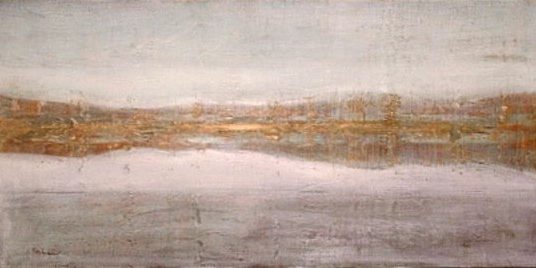
La linea è a volte corpo di suoni che ‘scrive’ di moti d’acque tra cieli e terre, o del loro riecheggiare visivo e sonoro in mobili specchi d’acqua. Qualche linea sembrerebbe dire del particolare respiro di una città che si colloca tra cieli, acque e memorie, richiami, evocazioni di altre terre…
Nel produrre una sensazione di quiete che tradisce comunque l’inquieta mobilità interna, la linea dal profilo vibrante evoca la natura delle acque fluviali, o dei canali, e… il Suono dell’acqua, un suono fluttuante, che cresce e che avanza.
Essa è confine che unisce e distingue ciò che non può essere diviso: Cielo e Terra. Tra le due dimensioni si fa l’uomo, in quelle linee che sono vie ed insieme orizzonti mai uguali a se stessi.
Inquieti orizzonti dello sguardo del viandante, o di colui che interroga e si interroga.
Tutte le opere di Matsuyama sono animate da questa forma astratta dal reale, risuonante nel colore, ed interiorizzata fino ad assumere differenti valenze simboliche. Esse si presentano come ripetizioni nella differenza, di movimenti e vibrazioni ritmiche o aritmiche ed indicano due percorsi di lettura visiva ed intellettuale, che in questo ‘luogo’ (l’opera di Matsuyama) conducono al medesimo ‘conoscere’.
L’uno concerne quella ricerca che i latini chiamarono ‘reductio ad unum’, ricerca del principio unitario, unificante e sotteso all’articolarsi delle differenze. L’altro è un percorso deduttivo che produce il dispiegarsi e distinguersi delle differenze. Entrambi vanno situati all’interno dell’equilibrio tra segni e spazio visibilmente ~temperato’, proveniente dall’ordine interiore dell’artista, così come nel trasparire del rapporto (quasi sempre sotteso in un’opera) tra intento, progetto ed incidentalità. tra elaborata causalità ed irruzione della casualità nel fare artistico. La differenza nella ripetizione può produrre rottura, ma all’interno di un percorso (la ripetizione nella differenza) che sostiene la continuità.
Quale continuità?
Quella che si scrive nel moto, non certo nell’atrofica stasi di ciò che si ripete senza produrre svolgimento, poiché è necessario non confondere la quiete ordinata e l’equilibrio che sono principale qualità di alcune opere di Matsuyama, con l’immobilità. Il moto è divenire, trasformazione. La continuità è, dunque, in essenza, continuità nella e della trasformazione.
L’ascolto del suono interiore (e da interiorizzare) delle opere di Matsuyama è dunque anche ascolto del moto del suono il quale è antecedente ed insieme intrinseco alla percezione visiva del corpo della linea nello spazio.
Tra la percezione sensoriale di un’opera e la sua articolazione ed elaborazione intellettuale e linguistica, incontriamo spesso uno o più elementi che si traducono in accadimenti poetici e vengono a costituire i fondamenti della struttura significante dell’opera.
Nel lavoro di Matsuyama la poetica delle opere concerne essenzialmente il sempre diverso rapporto tra linea, colore, suono. Rapporto non duale, ma temano, in cui è proprio l’elemento terzo, il Suono, l’invisibile, ciò che è precluso allo sguardo, ad animare il visibile, fino a diventarne il principio ‘poetico che, risalendo al significato originario di ‘poesia’, (parola derivante da poiesis che significa ‘fare’), può elevarsi a principio creativo o, se si preferisce, a principio del ‘fare’ artistico.
Tra i suoni che operano nel farsi di questi luoghi (di questi quadri), è presente il Suono degli dei, e questo permette di introdurre antiche teorie (in particolare indiane) sulla genesi dell’universo in cui proprio il Suono è considerato origine del cosmo. La parola produce le differenze di cui si viene a comporre l’universo, ma ciò che investe la parola di questa potenza creatrice è ciò di cui essa è portatrice e custode, vale a dire il Suono primordiale, che si manifesta semplicemente in vibrazioni ritmiche, in pure qualità sonore.
In quanto principio, il Suono primordiale non ha suono, in quanto potenza creatrice che si fa verbo e si articola in parola, esso è vibrazione e ritmo, percepiti prima della forma.
L’essenza delle opere di Matsuyama è rintracciabile esattamente nella vibrazione e nel ritmo, sia esso armonico o disarmonico, e il linguaggio si fa corpo nell’infinita varietà delle possibili interazioni tra forma (in questo caso principalmente la linea) e colore.
L’energia di quest’ultimo si fa quanto mai prossima alla luce, là dove l’occhio incontra superfici bianche, la cui valenza simbolica è quasi universalmente connotata di ‘purezza.
Strettamente congiunta al colore, ricorre in queste opere la presenza di un altro elemento: la carta.
Nella sua consistenza sottile e nel suo farsi trasparenza, essa è presenza-assenza ora impercettibile ora percepibile; in virtù della sua particolare fibra e delle modalità d’uso adottate dall’artista, pur essendo tecnicamente sovrapposta alla superficie, è elemento che non si separa ma si coniuga al colore. Assimilata al corpo dell’opera, non è in alcun caso riconducibile ad un’impressione o sensazione di pura sovrapposizione, di intento decorativo o di ridondanza.
Nel coniugarsi a forme e colori, essa giunge, al momento della percezione, come elemento che vela e rivela, senza mai produrre offuscamento, l’energia del colore. In quanto increspata trasparenza e sottigliezza, la sua consistenza perde ‘realtà puramente materica ed acquisisce valenza ‘naturale, intendendo sottolineare con questo termine l’antica attitudine giapponese ad investire la natura di valenze simboliche strettamente connesse allo spirito, al sacro, al ‘divino’.
Di volta in volta, la carta potrebbe evocare fumi, nebbie, vapori, trasparire di luce, oppure produrre rarefazione che affina l’atmosfera dell’opera, dominata dall’intensità cromatica e sonora. Talvolta permette un più sottile e completo diffondersi ed espandersi della luce del colore all’interno dello spazio dell’opera. La vibrazione si fa quindi al contempo diffusa, estesa e rarefatta; la carta sottile attenua e riecheggia; oltre il suono, apparentemente associato e circoscritto nella struttura del corpo della linea, essa genera risonanze.
La suggestione della sottigliezza e leggerezza di questo elemento, presenza ricorrente fin dall’antichità in molti riti religiosi così come nella vita quotidiana e nell’arte giapponese, mi induce a rappresentare la cultura occidentale in termini di ‘cultura della pietra, e quella giapponese in termini di ‘cultura del legno, così come ‘cultura della carta. Se la possibile valenza simbolica che noi associamo alla carta è quasi solamente relativa alla calligrafia, allo scrivere o alla grafica contemporanea, occorre osservare che in Giappone la sua valenza simbolica (in particolare nel caso in cui sia bianca) è strettamente ed intimamente connessa allo spirito, alla ‘parte eterna dell’essere’.
Dall’associazione tra forma e colore nasce un alfabeto simbolico che procede da un lato dalla valenza di simbolo che il colore ha assunto universalmente (nelle differenze peculiari a ciascuna cultura o a ciascun individuo), e dall’altro riconduce la potenzialità simbolica del colore stesso (in relazione alla forma) all’elemento terzo già menzionato, all’invisibile suono che fa del quadro possibile luogo da percorrere in ascolto. L’ascolto, se favorito dalla concentrazione e dal silenzio dell’io, permetterà di sentire quella particolarmente intensa qualità del suono e della musica che consiste nel ‘muovere gli affetti. non c’è distanza tra la percezione sensoriale della configurazione forma-colore-suono e l’insorgere dello stato d’animo, del moto dello spirito, generato dall’energia dei colori di linee e segmenti che raccontano nello spazio dell’opera vibrazioni ed inducono alla vibrazione. Mai viene prodotto un segno di conclusione. Stà all’attento osservatore proseguire il tracciato, l’indicazione offerta dall’evocazione sonora e dal suscitare moti (interiori) di queste opere, affidandosi alla propria sensibilità, esperienza, intuizione e capacità di silenzio che va di pari passo con la capacità d’ascolto.
Testimonianza di qualcosa che ‘muove’ l’opera ed è al contempo immanente e trascendente l’opera stessa, il Suono senza suono rimane comunque attivo in essa, quale suo movente primario, elemento terzo che permette l’intuizione sottile del moto e della trasformazione.
L’apparentemente facile leggibilità della simbologia formale e cromatica si rivela gravida dell’invisibile presenza di un suono da ascoltare ‘senza orecchi, da recepire appunto come vibrazione e moto psichico. Il Suono del cuore, il suono interiore.
“Il Tao (‘Via’, ma anche ‘parlare, ‘parole ) all’origine genera l’Uno
l’Uno genera il Due
il Due genera il Tre
il Tre genera i Diecimila esseri
L’armonia nasce dal soffio del Vuoto intermedio.
(Lao-zi)
Monique Sartor
THE MOTION OF SOUND
In the classic Japanese tradition (and not only), to look at a painting means to move through it with your eyes. In other words, not to have ideas about what you were going to encounter because to proceed in the vision was a progressive action, coinciding with the gesture of unrolling, unwinding the painting (as in a scroll). In this context, the experience of looking was wandering. It took place in time, as well as in space.
The connection between the ancient act of observation (the pictorial work) and the meaningful trip, or journey is immediate and to be explored.
The gap between that way of exploring a painting and the path currently taken to observe-view a painting by Shuhei Matsuyama is proportional to the distance, the temporal separation (placed in antiquity compared to contemporary), terraqueous and cultural between east and west, over which the works of this artist extend a bridge, and thus set up a relationship of continuity in the transformation of the two “shores”.
“The dream of the shore, is another shore”
(Edmond Jabès)
The word ‘bridge’, when evoking its stylized image, is easily associated with the concept of movement, of ‘passing’ or ‘of passage’, and this visual element becomes, in the works of Matsuyama, the ‘center’ and heart. That is to say, a place of journeying and wandering: the line, and before it as well as in it, an occurrence of pulsations which record rhythms and arrhythmies, sonorous paths of ancient origins, as remote and present as a heartbeat and breathing.
Whatever the point-moment of beginning the vision-listening of a Matsuyama work, the eye is called to roam, iterating in one direction or another along changeable marks-reliefs and pulsations of lines.
The act of viewing is carried out along the way, movement which travels the apparent immobile space of the painting, and at the same time is driven, at times steadily and urgently by the materialization of lines which emerge with the same consistency and discontinuity of a ‘superficial’ relief of the painting, making two possible dimensions or ‘readings’ of it distinct.
Line: water confine between earth and sky? Whether they are sleek and fine, acute, or heavy and dense, luminous and reverberating until they become strident or withheld, contracted and shaded in their murmuring, these lines are gaps, fractured from the margins and inconstant movements between body and sound.
The sound is, in any case, an undeniable emanation of the body, and the latter is transformed by the issuing forth of the former.
Sometimes the line is a body of sounds which ‘writes’ of water motions between sky and earth, or their visual and resonant re-echoing in moving reflecting waters. Some lines would seem to speak of the particular breath of a city set among sky, water and memory, recollections, evocations of other lands…
In producing a sensation of rest which, however, betrays restless internal mobility, the vibrant profile line recalls the nature of fluvial waters or canals and… the Sound of water, a fluctuating sound that grows and advances.
It is the boundary which unifies and distinguishes between that which cannot be divided: Heaven and Earth. Between these two dimensions there is man; in those lines which are paths and also horizons which are never the same.
Restless horizons of the wanderer’s glance, or of one who asks and asks of himself.
All of Matsuyama’s works are animated by this abstract reality of form, resonant in color and internalized until they take on different symbolic values. They appear as repetitions of differences of movement and rhythmic or arrhythmic vibrations and present two paths for visual and intellectual reading, which in this ‘place’ (Matsuyama’s work) lead to the same ‘knowing’.
One of the paths concerns the search which in Latin is called ‘reductio ad unum’, i.e. search for the common denominator – unifying and directed at pointing out differences. The other is a deductive path which produces explanation and distinction of differences. Both paths are situated within the equilibrium between marks and visibly ‘temperate’ space which come from the interior order of the artist, like in the revelation of the relationship (almost always present in a work) among intent, project and occasion, and between causal elaboration and the fortuitousness eruption of being an artist. The difference in repetition can produce a break, but along the path (repetition of the difference) it supports the continuity.
What continuity? That which is written in motion; certainly not in the atrophy of that which is repeated without producing development. It is necessary to not confuse the orderly rest and equilibrium, which are principal qualities in some works by Matsuyama, with immobility. Motion is becoming, transformation. The continuity is in essence, therefore, continuity in and of transformation.
To listen to the interior sound of the works of Matsuyama (and to internalize it) is also to listen to the motion of sound, which is antecedent and at the same time intrinsic to visual perception of the body of lines in space.
Between the sensorial perception of a work and its intellectual and linguistic articulation and elaboration, we often find one or more elements which can be called poetic happenings and which make up the basis of the significant structure of the work.
In Matsuyama’s work, their poetic aspect essentially concerns the always different rapport between line, color, sound. Not a dual rapport, but a thematic one in which the third invisible element, sound, which is precluded from view, animates the visible until it becomes the main ‘poetic’ which, (returning to the original meaning of poem, derived from poiesis, meaning to ‘do’ or ‘make’) can rise up to be the creative beginning or, rather, the beginning of ‘making’ art.
Among the sounds which help create these places (these paintings), the sound of the gods is present, and this permits introduction of ancient theories (particularly Indian) regarding the beginning of the universe: Sound is considered the origin of the cosmos. The word produces the differences of which the universe is composed, but the word is bearer and protector of the creative power she invests, in other words, the primordial sound which simply manifests itself in rhythmic vibrations of pure resonant quality.
Because it is the beginning, primordial sound has no sound; because it is the creative power which is action and word, it is vibration and rhythm, perceived before it has form.
The essence of Matsuyama’s works can be precisely traced back to vibration and rhythm, whether it’s harmonic or in discord, and language takes shape in the infinite variety of possible interactions among forms (in this case, principally lines) and color. And the energy of this latter is as close as possible to light where the eye meets white surfaces; its symbolic value is nearly universally understood as ‘purity’.
Closely tied to color there is another element which is present in these works: the paper. In its fine texture and transparency it is both present and absent, in one moment imperceptible and in another perceptible. As a virtue of its particular fiber and use by the artist, while technically it is laid over the surface, it is an element which cannot be separated from, but rather is wed to the color. Absorbed into the body of the work, it is never connected to an impression or sensation of simple overlap, decorative intention or redundancy.
In conjugating forms and colors, it becomes, at the moment of perception, an element which hides and reveals, but never dims, the energy of the color. In its transparent rippling and fineness, its texture loses purely material ‘reality’ and acquires a ‘natural’ value; what I wish to emphasize is the ancient Japanese use of giving nature symbolic values tied closely to the spirit, to the sacred, to the ‘divine’.
Sometimes the paper can evoke rivers, fog, vapors, a release of light, or it can produce rarefactions which add to the atmosphere of the work, dominated by chromatic intensity and sound. At times, the paper permits an even finer and more complete diffusion and expansion of the light of the color within the space of the work. The vibration is at the same time diffuse, extended and rarified. The delicate paper attenuates and echoes not only sound, apparently associated with and surrounded by the structure of the body of lines, but it also generates resonance.
The suggestion of fineness and lightness of the element (recurrent aspects since antiquity in many religious rituals, daily life and art of Japan), leads me to speak of western culture in terms of ‘the culture of stone’, and Japanese culture in terms of ‘the culture of wood’ as well as ‘the culture of paper’. If the possible symbolic value we associate with paper is almost exclusively connected to calligraphy, writing or contemporary graphics, we should note that in Japan its symbolic value (in particular when it is white) is closely and intimately connected to the spirit, to the ‘eternal part of the being’.
From the connection between form and color, a symbolic alphabet is born which stretches from the universally held symbolic value if color (within the particular differences for each culture or individual) and the symbolic potential of color (in relation to form) to the third element: invisible sound which makes the painting a possible place for listening wandering. Listening, if favored by concentration and the silence of the self, makes it possible to hear that particularly intense quality of sound and music which consists of ‘moving affection’. There is no distance between sensorial perception of the form-color-sound configuration and the rising of the soul, of the motion of the spirit, generated by the energy of colors of lines and segments that tell in the space of the work about vibrations and bring forth vibrations. There is never a suggestion of conclusion. It is up to the careful observer to follow the signs, the indications offered by resonant evocations and stirrings of (interior) motion in these works, to trust his or her own sensitivities, experiences, intuitions and capacity for silence which all go hand in hand with the capacity for listening.
A witness to something that ‘moves’ the work and at the same time is immanent and transcendent of the work itself, sound without sound remains, however, active in it as its primary motivation, the third element which permits subtle intuition of the motion and transformation.
The apparently simple reading of the formal and chromatic symbolism reveals itself to be full of the invisible presence of a sound to be listened to without ears, to be perceived as vibrations and psychic motion. The Sound of the heart, the interior sound.
“Tao (‘way’, but also ‘speak’, ‘words’) at its origin generates the One
the One generates the Two
the Two generates the Three
the Three generates Ten thousand beings
Harmony is born of the blowing of the intermediate Emptiness
(Lao-zi)
by Monique Sartor