
PER SHUHEI MATSUYAMA
Con concentrazione laboriosa e distillata, carta su carta, veli di colore d’acqua su velo, crescono le nuove pitture di Matsuyama. Crescono nell’avvertimento lucido e sereno del tempo della formazione, e in una condizione affettiva e intellettuale in cui il pensiero è il gesto, e la mozione espressiva è il processo genetico dell’immagine.
Da anni, il tema attorno al quale Matsuyama svolge il suo percorso poetico è Shin-On, il suono, nelle mille epifanie in cui la mente e i sensi lo avvertono. È un suono di cui l’artista mira a una scrittura, a un inveramento sul piano dell’esperienza visiva: per via di atmosfere, di equivalenze emotive, di scorrimenti simbolici: soprattutto, di vibrazioni estetiche.
In passato, il riverbero di un tracciato assiale, in grado di intonare del suo svolgersi di variante microemotività, come per concentratissima sismografia, la tessitura superficiale, mirava a porre in tensione la pelle dell’immagine, a dirne un’evidenza assertiva appena irritata dalle rifrazioni luminose delle stratificazioni della carta.
il colore vi era svolto per tonalità disagiate, per scarti brevi e dissonanti, che mantenevano l’aroma dell’evocazione naturale, ma tendevano a una qualità disagiata, d’artificiosa e non compiaciuta bellezza.
Ora, con il ciclo ultimo di opere — ancora accompagnate da un corresponsabile commento musicale —Matsuyama tenta una partita ancor più complessa.
Da un lato, egli tende ad affrontare più direttamente la componente — la voglia — naturalistica della sua immagine, e ad accogliere la fervida ambiguità della sovrapposizione tra la linea corrente, con le sue risonanze
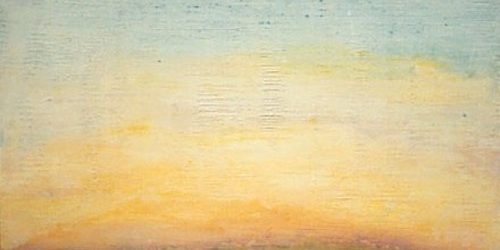
grafiche e cromatiche, e l’idea dell’orizzonte. Sempre meno assiale e sempre più abbassata, a schiudere alla visione un cielo pittorico straniato, tale traccia nasce ora, più che per decisione lineare, per differenziale cromatico, per scarto di qualità tonale. È, ora, una sorta di soglia, di border/ine energetica, in cui si intersecano profondità diverse: profondità che dicono, attraverso le gradazioni del colore, lontananze, e poetiche suggestioni cosmiche: rimemoranti, sia detto per non banale esotismo, i grigi, i rossi, i celesti lontani di Hokusai.
A tale più accentuata mozione naturale corrisponde, nel tempo recente del lavoro di Matsuyama, la volontà di espandere l’area di incidenza dell’operazione pittorica oltre le sue forme canoniche.
La serie di pannelli di ostentata verticalità, a far da quinta anche fisica della visione e da “pascolo” del suo tempo di lettura, i cilindri che rimbalzano all’esterno, nello spazio d’esperienza, la tensione radiante dell’immagine: e gli archi, le ogive: tutto, ora, concorre in Matsuyama verso una complessiva qualità ambientale dell’operazione pittorica (il rapporto con la colonna musicale vi si fa, così, assai più stringente), con precisa consapevolezza di integrazione architettonica.
L’atmosfera, dunque, la qualità sonora dell’immagine, si svolge da dentro a fuori la forma pittorica vera e propria, senza che essa se ne snaturi: è un micromondo, parte di altri, concatenati e congruenti, micromondi.
Matsuyama, infine, riesce a concertare per lo spettatore un’omogenea e sospesa condizione affettiva di lettura: per chi lo voglia, una condizione effettivamente meditativa.
di Flaminio Gualdoni
FOR SHUHEI MATSUYAMA
It is with laborious and carefuly weight concentration that, sheet upon sheet of paper, layer upo layer of watercolor, Matsyama’s new painting grow. They grow in the lucid and serene awareness of the time of their formation, and in emotional and intellectual condition in which thougbt is action, and the movement of expression is the genetic process of theimage.
For years, the theme around which Matsuyama develops bis poetics has been Shin-on, sound, in the myriad manifestations in which it is perceived by the mind and senses. It is a sound from which the artist alms to create a sort of script, a realization on the plane of visual experience by way of atmospheres, of emotional equivalences, of symbolic slippages above all, of aesthetic vibrations.
In the past, reverberation of an axial layout, capable of tinging the surfase texture with its tiny variations of emotivity, as if through a highly concentrated seismography, he sought to put the surface of the image under tension, to give it an assertive evidence that is very slightly heightened by the way that the layers of paper refract the light.
The color was applled in uneasy tones, with small and jarring differences, that rnaintalned the flavor of an evocation of nature but tended to produce a troubled quality, of contrived and not indulgent beauty.
Now, with his latest cycle of works — still accompanied by an accessory ,musical commentary — Matsuyama has attempled an even more complex set of variations.
On the one hand, he tends to tackle the naturalistic component — desire — of his image in a more direct manner, and to contain the fervent ambigulty of the superimposition between the flowing line, with its graphic and chromatic reasonances, and the idea of the horizon. Less and less axial and brought lower and lower down, to reveal the vision of an alien pictorial sky, this trace now emerges not so much from linear decision, but out of chromatic differential, of a deviation in tonal quality. It is, now, a sort of threshold, a borderline of energy, in which different depths intersect with one another: depths that speak, through the gradations of color, of distances, and poetic cosmic suggestions: reminiscent, to make an exotic comparison that is not banal, of Hokusai’s distant grays, reds, and blues.
This more accentuated natural motion in Matsuyama’s recent work correspons to a desire to expend the area of incidence of the operation of painting beyond its canonical forms.
The series of panels of ostentatious verticality, which also acts as a physical side
—scene to the vision and as a “pasture” in which to take time over their perusal, the cylinders that reverberate outward into the space of experience, the radiant tension of the image, and the arches, the ogives: all this, now, is taking Matsuyama in the direction of an all—embracing environmental quality of the operation of painting (making the relationship with the musical accompaniment even closer), with a precise awareness of architectural integration.
The atmosphere, then, the sonorous quality of the image, moves from the inside to the outside of the actual pictorial form, without perverting its nature it is a microw orld, a part of other, concatenated and congruent microworlds.
Matsuyama, finally, succeeds in contriving a homogeneous and suspended emotional state of interpretation for the observer for those who wish it, a truly meditative state.
by Flaminio Gualdoni