
SHUHEI MATSUYAMA – SHIN-ON: LA VISIONE DEL SUONO
La questione di rapportare l’arte visiva alla musica, di far derivare cioè le immagini del Suono, ha conosciuto nella ricerca artistica europea di questo secolo esperienze di grande importanza formale.
All’inizio di questo straordinario ciclo di dipinti, nel 1993, scrivevo tuttavia che “la proporzione immaginativa dì Shuhei Matsuyama rappresentava visivamente le molteplici significazioni del che ‘ideogramma ha specificato nella scrittura e nella cultura giapponese”.
Si trattava dunque di una ricerca diversa da quella europea, sia nei modi che negli esiti formali.
La ricerca dell’artista si è sempre manifestata nel particolare segno di una
“silenziosa rappresentazione del suono” – peraltro concretamente partecipe nelle cinque mostre su questo tema allestite a Venezia in circa un decennio – affidata a materiali (la carta d riso, ad esempio) e ad una concezione riflessiva (l’orizzonte del suono. per citare una sola cosa) tipicamente orientali.
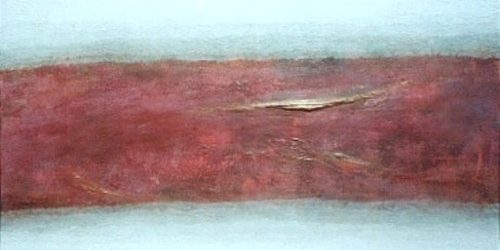
Mentre infatti la “linea centrale” dei suoi dipinti indicava “un sopra ed un sotto” della percezione del suono, come due livelli sensitivi di ascolto, i grumi e gli accumuli della carta dì riso ne testimoniavano invece “gli strappi e le lacerazioni”, quelle che con altre parole potremmo definire le “dissonanze”.
Se non propriamente comprensibili ad una prima occhiata, queste caratteristiche dell’opera di, Matsuyama venivano tuttavia percepite anche da un osservatore occidentale disposto a lasciarsi prendere emotivamente da una visione immaginativa estremamente accattivante e fortemente coinvolgente.
I più recenti lavori dell’artista giapponese – anch’essi ispirati o determinati dallo , -presentano tuttavia caratteristiche nuove che confermano un più complesso momento dì riflessione ideativi che molto semplicemente potremmo definire di “ascolto diffuso e avvolgente”.
Accade infatti che i nuovi dipinti di Matsuyama non presentino più la struttura determinata dalla “linea dell’orizzonte del suono” ma, al contrario, appaiono determinati da una occupazione completa ed imparziale dello spazio, reso così pienamente ed unitariamente significativo.
Si potrebbe perfino dire, per certi versi, che le sue immagini siano divenute apparentemente più “naturalistiche” e che il suono che esse “rappresentano” è dunque quello segreto della natura, quello persistente del mondo, senza alcuna fonte precisa, diffusa ed avvolgente, per l’appunto.
E’ difficile dire se tutto ciò rappresenti un punto di arrivo o di partenza nella ricerca o Matsuyama. ma e evidente che da un punto di vista strettamente pittorico questi lavori configurano una elaborazione ideativamente più complessa che perviene ad esiti formali dì rinnovato interesse.
Si potrebbe invece dire che in qualche maniera l’autonomia della pittura ha sopravanzato la difficile ed ansiosa ricerca della rappresentazione visiva del suono che caratterizzava i precedenti lavori.
Per la verità anche all’inizio del ciclo abbiamo sempre parlato della prevalenza del valore della pittura sulla rappresentazione nell’opera di Matsuyama, perché dicevamo allora, “la poesia non si fa con i sentimenti o con le intenzioni ma con il linguaggio”.
La grande tempera di Matsuyama ha dipinto in questa occasione e che costituisce il punto focale della mostra, non presenta più punti di riferimento visibili e riconoscibili per “l’ascolto del suono”, che appare dunque come disperso in una visione che potrebbe apparire perfino di origine paesaggistici. In realtà questo grande dipinto non ha molto a che fare con la natura e sembra piuttosto un’accesa visione “turneriana”.
E dunque la questione della luce – peraltro centrale in tutta la storia dell’ari occidentale – che adesso entra prepotentemente in gioco nell’opera Matsuyama, Forse perché questo ciclo d. dipinti è nato ancora una volta per Venezia, il luogo del mito dove il grande Turner scopriva nel 1819 il segreto della forma che dissolve nella luce diffusa riflessa dall’acqua, imparziale e senza ombre.
La musica assume allora, nell’opera più recente di Matsuyama, la connotazione di un nuovo pretesto immaginativo che l’artista giapponese utilizza per un percorso che potremmo definire “dal colore del Suono alla luce del suono”.
Più semplicemente e evidente che il suo itinerario è quello che in definitiva “dalla pittura alla pittura”, perché la sua attenzione è volta sostanzialmente all’apparizione di un evento visivo formalmente autonomo e prima di allora inesistente.
Un evento né descrittivo né narrativo, antimimetico di alcunché, che non e conto dei segreti riferimenti ideativi di cui si avvale.
Ma forse è proprio in questa sorta di “sacra ambiguità dell’immagine” che risiede il fascino di una lirica proposizione immaginativa che non ha a che tare coni quotidiano ed il reale.
E che persegue invece l’utopia di far vedere – o forse sentire ed ascoltare – è invisibile, come per l’appunto e’”il suono dell’arte”.
Enzo Di Martino
Venezia, maggio 2001
SHUHEI MATSUYAMA – SHIN-ON: VISION OF SOUND
The matter or relating visual art to music (i.e. to derive images from sound) has experienced considerable formal importance in European artistic study during this century.
At the beginning of this extraordinary cycle of paintings (in 1993) I wrote, however, that “Shuhei Matsuyama’s imaginative proposal visually represent the multiplicity of meanings for <sound> that the ideogram <Shin-On> specifically has m Japanese writing and culture.”
Therefore, we are speaking about a type of study which is different from the European one, both in the methods and the formal results.
The artist’s study has always been manifested in the particular sign of a “quiet representation of sound” — he has been a concrete participant in the five exhibitions on this theme in Venice over the course of about a decade — which he has entrusted to materials (e.g. rice paper) and to a reflexive concept (the horizon of sound, to cite only one example) which are typically oriental.
Indeed, while the “central me” of his paintings indicated “a top and a bottom” to the perception of sound, as two levels of sensitive listening, the clumps and accumulations of rice paper were, instead, testimonials to “tears and lacerations” which we can define in other words as “discords”.
Even if these aspects are not totally comprehensible at first glance, these characteristics of Matsuyama’s work have however been noted by a western observer who was open to letting himself emotionally carried by an imaginative vision that is extremely captivating and greatly enthralling.
The most recent works by the Japanese artist – also these are inspired or defined by <Shin-On> -. present however new characteristics which confirm a more complex moment of ideative reflection which we can very simply define as “diffuse and enveloped listening”.
in fact, the new paintings by Matsuyama no longer present structure as determined by the “line of the sound horizon” but rather seem to be defined by a complete and impartial occupation of space, thus rendering it significant both fully and unitarily.
It would even be possible to say, in a certain way, that his images have become apparently more “naturalistic” and that the sound that they “represent” is the secret one of nature, the one that is persistent in the world, which has no precise source and which, in fact, is diffuse and enveloping.
It is difficult to say if all this represents a point of arrival or of departure in Matsuyama’s study, but it is obvious that from a strictly pictorial point of view these works depict a more complex ideative elaboration than that which comes from formal results of renewed interest. Instead, one could say that in some way the autonomy of the painting has surpassed the difficult and anxious search for the visual representation of sound which characterized previous works.
Indeed, also at the beginning of the cycle we spoke about the prevalence of the painting’s value over the representation of Matsuyama’s work because, as we said then, “poetry is not made with feelings or with intentions but with language”.
Matsuyama’s large tempera, which he painted in this occasion and which constitutes the focal point of the exhibit, does not present visible and recognizable “listening-to-sound” reference points, however it appears as if lost in a vision which could even have a landscape origin.
In reality, this large painting does not have much to do with nature and seems instead a bright “Turnerian” vision.
It is a question of light — which is central to all western art history —that now enters the scene overbearingly in Matsuyama’ s work.
Perhaps because this cycle of paintings was born, again, for Venice, site of the myth where the great Turner discovered, in 1819, the secret of form which dissolves in diffuse light reflected by water, impartial and without shadow.
Music takes on, then, in Matsuyama’s most recent work, the connotation of a new imaginative pretext that the Japanese artist uses for the path which we can call “from the color of sound tu the light of sound”.
More simply, it is evident that his itinerary is that which, in conclusion, goes “from the painting to the painting” because his attention is directed, in essence, to the apparition of a visual event which is formally autonomous and which before then was inexistent. An event which is neither described nor narrated, anti-mimetic of nothing, that does not consider the secret ideative references of which it makes use. But perhaps the fascination lies in precisely this sort of “sacred ambiguity of the linage”, of an imaginative lyrical statement that bas nothing to do with daily routine and reality.
And that follows, instead, the utopia of showing — or perhaps hearing and listening — that which Is invisible, indeed, that which is “the sound of art”.
by Enzo Di Martino
Venice, May 2001