
SHUHEI MATSUYAMA: L’ORIZZONTE VISIVO DEL SUONO
Vi sono eventi visivi che dichiarano immediatamente ed esplicitamente il loro significato, la loro volontà di comunicazione, il loro esplicito intento descrittivo o narrativo; ed altri che nascondono invece sotto la pelle delle apparenze intenzioni non leggibili a prima vista, messaggi visivi non decifrabili facilmente, valori non riconoscibili alla prima occhiata. L’opera pittorica di Shuhei Matsuyama appartiene al secondo ordine di eventi figurali perchè dietro le vesti apparenti ed inoffensive di “paesaggi” nasconde a ben vedere intenzioni e valenze che reclamano una occhiata lunga ed insistita per essere disvelate e richiedono una “attenzione riflessiva” che non ha a che fare soltanto con l’arte per essere interpretate.
La proposizione immaginativa di Matsuyama, che si manifesta nelle sembianze di tavole dipinte di sapore vagamente naturalistico, è in effetti ispirata e “rappresenta~~ visivamente le molteplici significazioni del “suono” che l’ideogramma” Shin-On” ha nella scrittura e nella cultura giapponese.
Non si tratta evidentemente di un reale riconoscimento visivo perchè Matsuyama dipinge “concetti sonori” difficili da trascrivere e da ritenere, specie per un occidentale, quali ad esempio “il suono del cuore” o “ il suono della fede”.
Come per “la statica figurazione del movimento” ,in altri momenti storici della pittura, si può dunque parlare in questo caso di una sorta di “silenziosa rappresentazione del suono”, una operazione pittorica e concettuale in grado di far” vedere l’invisibile e di udire ciò che non si sente”.
Non a caso il testo pìu interessante – e forse fondamentale per la sua comprensione – finora apparso sull’opera pittorica di Matsuyama, è stato scritto da Monique Sartor, con una vasta e complessa gamma di elementi riflessivi e di riferimento, servendosi però di chiavi di lettura che in definitiva poco hanno a che fare con l’arte e con la cultura occidentali. In quel testo si parla tuttavia di “percorsi sonori”, di “sguardo viandante”, di “suono invisibile”, di concetti, vale a dire, che sono assonanti con quelli di un “riguardante frontale” come può essere un critico d’arte, interessato cioè alla sola manifestazione della pittura, alla sola organizzazione del linguaggio espressivo.
Innanzitutto è evidente, allora, come il suono appartenga ad una espressività di concezione astratta che precede l’apparizione della forma e che si colloca dunque al principio della vicenda dell’uomo.
E’ perciò probabile che nell’opera di Matsuyama solo uno “sguardo errante”, insistito ed ellittico,”uno sguardo di ascolto”, si potrebbe dire, può giungere a riconoscere la storia e la memoria dell’uomo e dello stesso artista.
Un artista giapponese che, non dimentichiamolo, vive tuttavia in Europa da molti anni – in Italia – e che confronta dunque la sua espressività visiva (non dico quella emotiva) anche con le vicende della ricerca della pittura contemporanea e con la storia dell’arte del Paese in cui opera.
Dinnanzi ai dipinti di Shuhei Matsuyama occorre allora mettere in atto una sorta di strategia di avvicinamento ai significati che consenta di evitare di cadere nelle numerose e fuorvianti trappole interpretative ed emotive di cui essi sono disseminati.
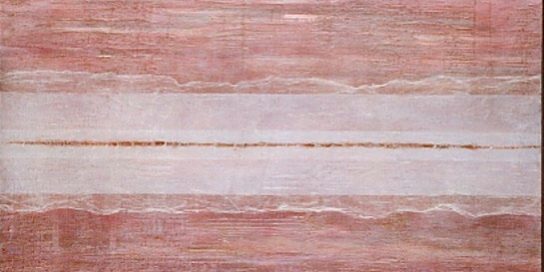
Innanzitutto quella “naturalistica”, confondendo la sua “linea del suono” – di solito orizzontale e centrale nell’immagine – con il segno di un orizzonte, un confine tra cielo e terra che dovrebbe indicare, scandire anzi, un paesaggio ideale.
Il suo segno – solco separa piuttosto il “sopra ed il sotto” del limite di percezione di un “suo
no interiore” il cui ascolto avviene con gli occhi piuttosto che con le orecchie, una sorta di “orizzonte del suono”, dunque, un limite estremo “oltre il quale non si sente più niente”.
Interessante appare a questo punto notare che Matsuyama nei suoi lavori esibisce la struttura stessa della pittura, la sua materia cioé – il gesso, la carta, il colore – che si fa, alchemicamente, essa stessa messaggio.
In questo senso l’artista giapponese assume chiaramente la convinzione – e la responsabilità – che così come la poesia non si fa con i sentimenti o con le intenzioni ma con il linguaggio, dunque con le parole, anche la pittura si manifesta non con i significati (le descrizioni, i racconti) ma con i suoi mezzi più specifici (ancora una volta il linguaggio), vale a dire i segni (i gesti) ed il colore (la materia).
La carta di riso che Matsuyama utilizza per la costruzione stratificata del supporto pittorico assume a questo proposito una doppia e fondamentale valenza.
Da un lato è essa stessa materia esibita della pittura, parte integrata del colore e infine elemento rivelatore della stessa immagine finale.
Dall’altro, come ha scritto esemplarmente Monique Sartor, “la suggestione della sottigliezza e della leggerezza di questo elemento,presenza ricorrente fin dall’antichità in molti riti religiosi così come nella vita quotidiana e nell’arte giapponese”, inducono ad assegnare alla carta una sorta di valenza magica e simbolica nell’opera di Matsuyama, quella “strettamente ed intimamente connessa allo spirito, alla parte eterna dell’essere”.
Le vibrazioni formali che le sue lievi increspature determinano nel tessuto pittorico di Matsuyama,quei fremiti emotivi che addensano il campo di apparizione della “linea del suono”, quella stesura progressiva per strati che pare indicare diversi livelli di conoscenza dell’opera, configurano perciò un evento che è formale ma anche sacrale nel medesimo momento.
Lo stesso gesto che traccia il solco nella materia pittorica, del resto, un gesto doloroso dotato di una sorta di significato sacrificale, è condizionato dalla presenza della carta e “gli strappi e le lacerazioni del suono” si verificano dunque in dipendenza di uno scontro, di un conflitto con questo materiale che diviene così decisivo nella manifestazione della proposizione immaginativa di Shuhei Matsuyama.
Viene naturalmente da osservare,a questo punto,come l’opera pittorica dell’artista giapponese – pur avendo a che fare, inevitabilmente, con molteplici lezioni storiche – possegga una sorta di autonomia formale che si riflette su se stessa, che sembra nascere da una magica confluenza di riferimenti culturali e forse perfino da una dilacerante dualità, ma che si manifesta infine con una indipendenza espressiva che sembra rispondere a regole interne di cui l’artista non da conto, configurando per tale via un evento visivo che, al di là di ogni altra considerazione, reclama in definitiva il solo diritto all’apparizione ed alla contemplazione.
Come avviene sempre del resto nelle opere d’arte e di poesia, nelle quali è il linguaggio -quello verbale e quello visivo – a determinare alla fine la caratterizzante “inevitabilità” della loro manifestazione, ed il segno inconfondibile della loro persistenza nel tempo.
di Enzo Di Martino
Venezia 15 Aprile 1993
SHUHEI MATSUYAMA: THE VISUAL HORIZON OF SOUND
There are visual events that declare their meaning, their will to communicate, and their explicit descriptive or narrative intention immediately and explicitly. Others hide, under the skin of their appearances, intentions illegible at first glance, vìsual messages not easily decipherable, and values at first unrecognizable. Shuhei Matsuyama’s pictorial work belong to the second order of figural events. Behind the apparent and inoffensive clothing of his ‘landscape’, there hides, upon closer inspection, intentions and values the unveiling of which claims the right to a long and insistent look. Their interpretation demands ‘thoughtful attention’ and has to do with something that goes beyond art alone.
Indeed Matsuyama’s imaginative proposition, which he manifests in the form of paintings with a vague naturalistic flavor, is inspired by and visually ‘represents’ the manifold meanings of ‘sound’ that the ideogram ‘Shin—On’ represents in Japanese writing and culture. Evidently it is not a matter of real visual recognition, because Matsuyama paints ‘sonorous concepts’ that are difficult to transcribe and to hold, especially for a Westerner
— concepts such as ‘the sound of the heart’ or the ‘sound of faith’. Thus, as in ‘the static figuration of movement’ from other moments in the history of painting, one could speak of this as a sort of ‘silent representation of sound’, a pictorial and conceptual operation capable of making ‘the invisible visible and of listening to that which cannot be heard’.
It is not by chance that the most interesting text that has appeared until now on Matsuyama’s painting — one which is perhaps fundamental in understanding his work — is written by Monique Sartor, with a vast and complex range of thoughtful elements and references, through the use of interpretive means that in the end have very little to do with art and with Western culture. The text speaks mostly about ‘sonorous routes’, about ‘the traveller’s glance’, about ‘invisible sound’, and about ‘concepts’; that is to say, ones that are assonant with those of a ‘frontal viewer’ such as an art critic might be, interested only in the manifestation of the painting and the organization of the expressive language.
Above all it is evident that the sound belongs to an abstract conception of expressiveness that precedes the apparition of the form and, therefore, places itself at the beginning of the events of man. In Matsuyama’s work it is probable that only an insistent and elliptical, an ‘errant’, you could say ‘listening’, glance could manage to recognize this history, the memory of man and the artist himself.
Matsuyama is a Japanese artist who, it should be remembered, has lived for the most part in Europe — in Italy — for many years. Thus he also confronts his visual (I won’t say emotive) expressiveness with the events of the contemporarv pictorial research and the history of art in the country where he works.
Therefore it is necessary to use a sort of strategy in front of Shuhei Matsuyama’s paintings in order to come close to their meanings, a strategy that permits one to avoid falling in the numerous and misleading interpretive and emotive traps with which they are strewn. Above all there is the ‘naturalistic’ trap, where the ‘sound line’ — which is usually horizontal and central in the image — is confused with the sign of a horizon, a border between
the sky and the earth that should indicate, or rather scan, an ideal landscape. Instead Matsuyama ‘s sign-wake separates the ‘above and the below’. It must be listened to with the eyes rather than the ears, as a sort of ‘sound horizon’ and, therefore, an extreme limit ‘beyond which nothing else is heard’.
At this point it is interesting to note that, in his works, Matsuyama exhibits the structure itself of the painting; that is, the material — the gesso, the paper, the paint — that in itself, alchemically, makes up the message. In this way this Japanese artist clearly assumes the conviction — and the responsibility — that painting is like poetry. The latter is not made with sentiments or with intentions but with language, and therefore with words; painting too is not only manifested through meanings (descriptions, stories) but through its more specific means (once again, language); that is to say, the signs (the gestures) and the color (the material). The rice paper Matsuyama utilizes for the layered construction of the pictorial support assumes a double and fundamental value in this regard. On one hand it itself is material exhibited by the painting, an integrated part of the color and, in the end, a revealing element of the same final image. On the other, as exemplarily written by Monique Sartor, ‘the suggestion of the subtlety and the lightness of this element, a presence reoccurring since antiquity in many religious rites and in Japanese daily life and art’, leads to assigning a sort of magic and symbolic value to the paper in Matsuyama’s work, one that is ‘strictly and intimately connected to the spirit, to the eternal part of being’.
The gentle ripples of the formal vibrations define Matsuyama’s pictorial fabric: the emotive quivers that thicken the field of apparitions of the ‘sound line’ and the progressive layering that seems to indicate different levels of consciousness in the work. They shape an event that is formal and sacral in the same moment. The very gesture that traces the wake in the pictorial material — a painful gesture endowed with a sort of sacrificial meaning — is conditioned by the paper’s presence and thus ‘the tears and lacerations of the sound’ are dependant upon a clash, a conflict with this material that becomes decisive in the expression of Shuhei Matsuyama’s imaginative proposition.
It is natural to observe at this point how this Japanese artist’s work — though inevitably having to do with various historical lessons — possesses a sort of formal autonomy that reflects upon itself, that seems to be born from a magic confluence of cultural references and perhaps even from a lacerating duality. Yet, in the end, it is manifested with an expressive independence that seems to respond to internal rules for which the artist does not account. They shape a visual event that, beyond every other consideration, in the end, claims only the right to appear and to be contemplated. It is the same as in all works of art and poetry, where finally the language — verbal or visual — establishes the characterizing ‘inevitability’ of their expression and the unmistakable sign of their persistence over time
by Enzo Di Martino
Venice April 15 1993