
SHIN-ON, IL SUONO DEGLI OCCHI
Nel quadro delle ricerche che io mi sforzo di mostrare a chi ha interesse a guardare dell’arte anche l’aspetto….artistico, mi sarebbe sembrata una notevole dimenticanza non prendere in esame anche una scuola tanto differente dalla nostra come è quella giapponese, basata su una cultura e una società che consente punti di vista e di considerazione completamente differenti dai nostri, e quindi di assoluto interesse per una più ampia visione culturale per chi ama sapere, essere informato. Del resto la stessa lingua, il modo di dialogare delle persone, la scrittura che è di per se stessa una forma artistica, tutte le innumerevoli regole cerimoniali che accompagnano la vita dei giapponesi, regole che hanno sempre differenti significati che nascono a loro volta da una serie di ragioni, regole che non vengono cambiate malgrado il Giappone sia forse oggi il paese più avveniristico del mondo, dal punto di vista delle soluzioni ambientali e della organizzazione sociale, ma anzi vengono gelosamente conservate perché parte essenziale, indiscutibile, dell’anima di questa civiltà così avanzata e così conservatrice allo stesso tempo, lo stesso modo di porsi dinnanzi ad un problema, ad un avvenimento, l’insegnamento della storia, l’approccio alla natura, la sacralità del lavoro ecc. tutto questo fa del Giappone e della sua cultura il simbolo della calma filosofica, delle sottigliezze mimiche, della sofisticazione dello Zen. E’ quindi ovvio constatare che l’espressione artistica di un giapponese rappresenta qualcosa di differente da quella di un italiano o di uno svedese. Questo vale naturalmente anche per l’arte cinese e per quella indiana, delle quali spero di poter presentare un giorno qualcosa di interessante, così da poter rispettare la mia idea iniziale, di quando ho aperto questo spazio voglio dire, che era di fare sopratutto della cultura perché l’arte è un fatto culturale e, indipendentemente da tutti gli interessi che muove, come tale deve sempre essere considerata, se si vuole amarla veramente, e comprenderla.
E quindi eccomi con un’artista giapponese di buona considerazione, un’artista che divide la sua esistenza fra il suo paese, che rappresenta benissimo per cultura e tradizioni, e il nostro. Un uomo con il quale ho sempre avuto molto piacere a discorrere perché il suo essere e assolutamente diverso dal mio, così maledettamente impaziente, pragmatico, “occidentale”, e questo crea in me un interesse particolare, non solo per l’artista ma anche per l’uomo.
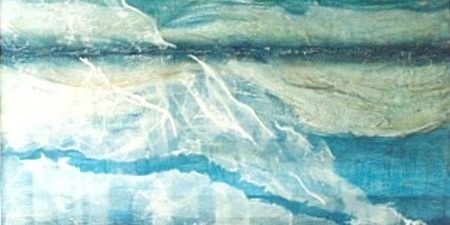
Per parlare del lavoro di Shuhei Matsuyama occorrerebbe innanzi tutto consigliare di non fermarsi alla sola impressione visiva, all’emozione dell’opera considerata fine a se stessa, come del resto dovrebbe(potrebbe) anche essere logico, per la regola tutta nostra che un’opera d’arte non dovreb-be contenere messaggi. Questo perché la prima impressione, guardando da occidentali, viene direttamente, come è capitato anche a me, da un giudizio assolutamente estetico delle opere. Grave errore, perché in queste opere il segno, il colore derivano da matrici letterarie, poetiche, filosofiche. Qui siamo di fronte ad una massa d’acqua che se è ferma vuol dire una cosa, se ha un lieve movimento ne vuoI dire un’altra e se ha un movimento più visibile ne dice un’altra ancora, e tutti i significati possono poi cambiare a seconda della direzione del movimento, dell’intensità di colore della massa e così via. Si tratta di un sofisticatissimo rincorrere cose che stanno ferme, immobili da tempo infinito, ma che non si riesce ad afferrare perché altrimenti sarebbe troppo logico, e quindi questo rincorrere viene disegnato, e segnato, affinché si riesca a tracciare una connotazione possibile per i nostri sensi limitati, per cui viene spontaneo, a chi come noi non possiede il senso orientale di osservare, di limitare il tutto alla emozione che viene dall’occhio. Qui abbiamo un suono, Shin-On, che viene da fonti accese migliaia di anni fa, un suono che nessuno di noi può evidentemente aver mai sentito, ma che pure è nato, è esistito e ancora percorre l’infinito e oggi viene rinforzato dal suono nuovo di queste opere. Quale di questi suoni, tutti espressi con l’identica fonetica, Shin-On, esce da queste opere? Non è forse Shin-On il suono del cuore, oppure il suono vero, oppure il suono fluttuante o quello profondo o quello degli dei? Quanti suoni esprime Shin-On in questa lingua che sembra dura alla pronuncia, ma che esprime situazioni di così alta poesia? Dieci, venti, non ha importanza. Perché tutto ha un suono, per un orientale, un disegno e una pietra hanno un suono, un albero, una stella e un tramonto hanno un suono. Alla prima enunciazione Shin-On seguirà quindi una serie di chiarimenti fino a che non sarà trovata 1’ identificazione perfetta: perché questo è il modo assolutamente giapponese di indagare, e perché in queste opere è teoricamente contenuta l’origine del suono, e praticamente il suono può essere visto, perfino udito.
Ma per noi è differente. Io penso che difficilmente sarà per noi possibile entrare in atmosfere così prive di materialità, perché la nostra anima occidentale fatica a camminare in assenza degli usuali punti di riferimento, si spaventa della rarefazione emotiva e quindi ci accontenteremo di stare a quello che ho denunciato prima come errore ma che, in definitiva, ci permetterà di apprezzare anche le indubbie qualità artistiche del nostro artista. Ci terremo dentro questi significati orientali che stanno in queste opere e, se ne appenderemo una nella nostra casa, ogni tanto la “ascolteremo” per cercare di carpire il segreto di questi suoni, Shin-On, che queste opere esprimono. Perché questi suoni esistono: assolutamente, definitivamente. Ho avuto su questo spiegazioni lunghissime e interessantissime, che voi mi scuserete se non riporto in queste righe, perché avrei dovuto scrivere un libro anziché una semplice presentazione….
di Enrico Gariboldi
SHIN-ON, THE SOUND OF EYES
Within the field of research that I make an effort to show those interested in looking at also the… artistic aspect of art, it would seem an oversight to not take into consideration a school which is so different from our own as is the Japanese school. It is based on a culture and society which permits points of view and considerations which are completely different from ours, and thus of great interest for a wider cultural vision for those who love to know and to be informed. Even its language, style of dialogue among people, and writing are artistic form; the innumerable ceremonial rules which accompany the life of the Japanese, rules which always have other hidden meanings which, in turn, originate from a series of reasons; rules that do not change despite the fact that Japan is today perhaps the most futuristic country in the world from the point of view of environmental solutions and social organization, but rather the rules are jealously protected because they are an essential, undeniable part of the soul of this civilization which is so advanced and so conservative at the same time; the way to stand before a problem, an event; the teaching of history, the approach to nature, the sacredness of work, etc. All these together make Japan the symbol of philosophical tranquility, of fineness of gesture, of Zen sophistication. Therefore it is clear that the artistic expression of a Japanese person represents something different from that of an Italian or a Swede. Naturally, this is also true for Chinese or Indian art, for which I hope one day to have the opportunity to present something interesting. That way, I would be able to respect my initial idea when I opened up this space, which was to make, above all, culture, because art is a cultural fact and, independently from all the related interests, it must always be considered as such if one wants to truly love it and understand it.
And so, here I am with a well considered Japanese artist. An artist who divides his existence between his country, which he represents perfectly for culture and tradition, and ours. A man with whom I have always enjoyed conversing with because his “being” is completely different from mine which is so infernally impatient, pragmatic, and “western”, and this creates particular interest for me not only for the artist but also for the man.
In order to speak about the work of Shuhei Matsuyama it would be necessary, first of all, to advise one to not stop at the simple visual impression, the emotion of the work considered as an end unto itself, as would (or could) be logical according to our rule that a work of art shouldn’t contain messages. I say this because the first impression, for a westerner, comes directly, as happened for me, from a completely aesthetic judgment of the work. And this is a big mistake because in these works the mark, the color derive from literary, poetic, philosophic matrices. We are in front of a mass of water that if it is still means one thing, if it is slightly moving means another, and if it has visible movement means still another. And all the different meanings can change depending on the direction of the movement, the intensity of the color of the mass, and so on. It is a very sophisticated running after things that are still, immobile throughout time, but that cannot be caught because, otherwise, they would be too logical, and so this running after is drawn and marked until it is possible to plot a possible connotation for our limited senses. Thus, it is natural, for people like us who do not possess an oriental sense of observation, to limit the whole thing to the emotion that comes through our eyes. Here we have a sound, Shin-on, that has its sources thousands of years ago, a sound that none of us evidently has ever heard, but that is born and exists and continues into the infinite, and today is reinforced by the new sound of these works. Which of these sounds, all of which are expressed with the same phonetic Shin-On, emanates from these works? Isn’t it maybe Shin-On the sound of the heart, or maybe the true sound; perhaps the fluctuating sound or deep sound, or the sound of the gods?. How many sounds does Shin-On express in this language that seems harsh in its pronunciation but speaks of situations of extreme poetry? Ten? Twenty?; the number is not important. Because everything has a sound for an oriental: a drawing, a stone, a tree, a star and a sunset all have a sound. At the first enunciation of Shin-On, there is a series of clarifications until the right one is identified: this is the uniquely Japanese way to investigate and why in these works the origin of the sound is theoretically present; the sound can be seen, even heard.
But for us it is different. I think it will be difficult for us to enter into an atmosphere which is so without materialism because our western soul finds it hard to walk without our usual points of reference, we are frightened by emotional rarefaction and so we are content to stay with what before I called a mistake, because at least it permits us to appreciate the unquestionable artistic qualities of our artist. We will hold the oriental meanings of these works inside ourselves and, if we hung one in our homes, every once in a while we would “listen” to it to try and understand the secrets of the sounds, Shin-On, that they express. Because these sounds do exist: absolutely and without a doubt. I have had extremely long and equally interesting explanations regarding this, and I hope you will forgive me if I do not refer them in these few lines, because I should have written a book about it, and not simple a presentation…
by Enrico Gariboldi