SHUHEI MATSUYAMA: PITTURA COME FILOSOFIA, FILOSOFIA COME PITTURA.
Gli estremi si toccano. Sei secoli prima di Cristo, un filosofo greco, Pitagora di Samo, ebbe l’intuizione che tutto in natura è numero.
Principio di tutte le cose è l’unità; dall’’unità nasce la dualità infinita che soggiace all’unità come la materia alla causa;dall’ unità e dalla dualità infinita vengono i numeri e dai numeri i punti, e da questi le linee, e da queste le figure piane, da cui vengono le figure solide e i corpi…L’embrione prende forma in quaranta giorni; il bambino viene alla luce in sette mesi,o in nove o al massimo in dieci, secondo le leggi dell’armonia… Ciascuna parte si inserisce nel tutto al momento giusto, secondo le leggi dell’armonia.” (Diogene Laerzio).
Ma se tutto è numero, tutto è ritmo, e quindi tutto è musica. Coerentemente, Pitagora pensava che le stelle si muovessero nello spazio siderale suscitando un suono armonioso, e che il firmamento risuonasse di musiche.
Gli estremi si toccano, dicevamo. Anche nella tradizione indiana la musica è il linguaggio originario, il linguaggio degli dei. Come nella tradizione cristiana “ in principio era il Verbo”, per la tradizione indiana “in principio era il canto”.
Gli estremi si toccano, ripetiamo. All’inizio del secolo il pittore russo Wassily Kandinsky intuisce che esiste una relazione, anzi un’equivalenza fra pittura e musica. Il colore è un suono interiore.
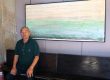
E oggi, mentre il secolo si chiude, siamo qui a visitare la mostra di un artista giapponese (ma ormai italiano, e milanese, d’adozione) Shuhei Matsuyama, che nelle sue opere dipinge lo shin-on, il suono delle cose. Il suono di tutte le cose. Il suono che è l’origine e insieme la rappresentazione di tutte le cose.
Tradizione orientale e occidentale, avanguardie di inizio secolo e esperienze di fine millennio sembrano dunque portare a una convergenza. Convergenza, sia chiaro, non significa identità, semmai il suo contrario: non avrebbe senso sottolineare lo stesso punto di arrivo, se i punti di partenza non fossero diversi.
Può sembrare pretestuoso muovere dai massimi sistemi, scomodare Superi e Acheronta per parlare di pittura. Ma in questo caso è necessario. Perché l’opera di Matsuyaina si nutre di filosofia: di una filosofia, appunto, alta, che tiene conto dello zen e delle grandi religioni orientali, ma trova inaspettati riscontri anche nel nostro pensiero. E nel nostro pensiero artistico.
Detto questo,occorre anche dire che, se Matsuyama parte da un’intuizione filosofica (la riducibilità di tutte le cose a una realtà ultima, che è appunto il suono, per cui la pittura non deve disperdersi nella rappresentazione delle singole apparenze, ma deve rappresentare la loro anima, cioè quella musica che le origina e le esprime) la sua opera non si riduce a filosofia.
Ma come? Non abbiamo appena detto che guardando un lavoro di Matsuyama occorre tener presente gli orizzonti filosofici in cui si colloca,per capire che non siamo di fronte a un esercizio sensibilistico, formale, stilistico, ma a un’esperienza sapienziale? E’vero. Lo scopo di Matsuyama non è la pittura, è la conoscenza. La sua pittura non esisterebbe se fosse solo un problema di tavolozza, di pigmenti e di pennelli. Per lui la pittura non è mai una questione di pittura.
Ma proprio perché il linguaggio è destinato a esprimere un significato profondo, bisogna che questo linguaggio (il linguaggio pittorico) sia il più possibile nitido, intenso, consapevole.
Ecco quindi che nelle opere dell’artista giapponese vediamo che il supporto (carta di riso, tavola di legno, tela, gesso o vetro che sia) è scelto con cura, in modo che sappia esaltare il valore luminoso della composizione.
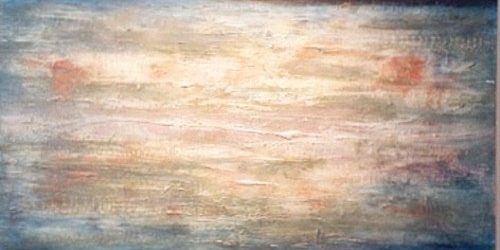
Anche la pennellata è data con sapienza: il colore si struttura come materia-colore, sovrapposizione di strati pittorici che si intensificano nel centro (nel baricentro) della composizione e lì conoscono convulsioni, ondulazioni, corrugamenti, screpolature, cicatrici. Perché è lì che il suono diventa più profondo, ma anche perché lì convergono gli sguardi.
Ancora, lo spazio è suddiviso armonicamente, obbedendo a una simmetria ideale, oppure a una sezione aurea calcolata non col compasso, ma col cuore.
Anche la predilezione per certi colori non è casuale. I colori di Matsuyama non sono mai immediatamente sgargianti, timbricamente alti, decorativi. Sono colori mentali, introversi, tacitamente commossi: colori che non squillano e non gridano, ma parlano attraverso il silenzio.
Le gamme degli azzurri (quell’azzurro che,per Cézanne, è il “colore della lontananza”); i repertori dei verdi iridescenti e acquosi; le variazioni sui bianchi di gesso e di madreperla; il catalogo dei neri enigmatici e malinconici; la fenomenologia dei rosa aurorali e minerali testimoniano che il colore non è sentito come aggiunta o come ornamento, ma come sostanza. Come sostanza spirituale.
E infine la linea. Matsuyama è pittore della linea. Tutti i suoi quadri nascono da una linea originaria che agisce come un taglio, nella superficie intatta dell’opera. La lezione di Fontana non è passata invano. Ma oltre a questa linea, che può essere centrale, impennarsi verso l’alto o precipitare verso il fondo del quadro, è la pennellata stessa, ogni pennellata, che si struttura come una linea, in modo da trasformare il tessuto dell’opera in una trama fitta e delicata di elementi segnici.
Si potrebbe dunque collocare l’opera di Matsuyama nell’ambito di quella “pittura analitica” (o “pitturapittura”) che a Milano ha avuto uno dei suoi centri, a partire dagli anni Settanta: una pittura,cioè,che vuole soprattutto affinare gli strumenti pittorici.
Per Matsuyama, lo abbiamo detto,le motivazioni artistiche sono diverse. Ma è comunque attraverso l’approfondimento degli strumenti della pittura,attraverso uno studio calmo e incontentabile,condotto al di fuori dei riflettori (come usa dire oggi) e davanti allo scrutinio della propria coscienza (come oggi non usa dire più) che l’artista giapponese giunge al significato. E alla bellezza.
Per lui vale l’espressione di Nietzsche, che parlava del “lento dardo della bellezza”. Ma una freccia non dovrebbe essere veloce? Nella realtà, certo. Ma nella realtà dell’arte,quello che piace immediatamente stanca presto. Mentre quello che ci raggiunge lentamente, perché richiede meditazione e sensibilità, lascia un segno che non si rimargina. E non si dimentica più.
Elena Pontiggia
SHUHEI MATSUYAMA: PAINTING LIKE PHILOSOPHY, PHILOSOPHY LIKE PAININGS.
Extremes meet. Six centuries before Christ, a Greek philosopher, Pytagoras of Samo, had the idea that everything in nature is number.
“The principle of everything is unity: from unity is born the Infinite duality like duality that is subjected to unity like matter to cause; from unity and from the Infinite duality come the numbers and from numbers the point, and from these the lines and from the these the flat images, from which come the solid images and bodies……..The embryo takes shape in forty days, the child is born in seven months, or in nine or in the maximum in ten, according to the laws of harmony….. Each part is connected to the whole at the right moment, according to the laws of harmony, “Diogenes Laertius.
But if everything is number, everything is rhythm, therefore everything is music . Pythagoras, consequently, thought that the stars moved in the sidereal space arousing a harmonious sound, and the firmament would resound with music.
Extremes meet, they would say. Also in the Indian tradition the music is the original languages, the language of gods<.like in Christian tradition “at the beginning was the world of god”, for the Indian tradition, instead, “at the beginning was the song”.
Extremes meet, they would repeat. At the beginning of the century, the Russian painter, Wasslly Kandisky, realized that there exist a relation, rather an evenness between music and painting. The colour is an Inner sound.
And today, while the century comes to an end, we are here visiting the exhibition of the Japanese artist ( but now Italian, and Milanese by adoption) Shuhei Matsuyama, who in his work, he paints the Shin-On, the sound of things. The sound of all things. The sound that is the beginning and together the representation of all the things.
Western and oriental tradition, avan-gardes at the start of the century and experiences at the end of millennium seem to come to a convergence. A convergence, let it be clear, that doesn’t mean identity, but its opposite: it wouldn’t make any sense to underline the same point of arrival, if the starting points weren’t different.
********
It may look like a present starting from the greatest systems, bothering Heaven and Hades in order to speak of painting. But in this case it is necessary, since the work of Matsuyama is nourished with philosophy: of a great philosophy that takes into account Zen and the great oriental religions, but also finds unexpected comparison in our western thought and in our artistic reflection.
Having said that, it is also necessary to point out that Matsuyama starts with a philosophical intuition ( the reducibility of all things to a reality, that is in fact the sound, for which painting shouldn’t dissipate in the representation of the individual appearances, but must represent their soul, which is the music that originally expresses them), but his work is not reduced to philosophy.
But now? Didn’t we just say that watching a picture of Matsuyama is necessary to keep in mind the philosophical aspects to which it belongs. In order to understand that we are not in front of a knowledgeable experience. It true, the objective of Matsuyama isn’t painting, it’s knowledge. His work wouldn’t exist if it were only a question of palette, of colouring-matter and brushes. For him painting it is never a question of painting.
But since language is destined to express a deep meaning, it is necessary that this language ( the language of painting) is as much as possible neat, intense, conscious.
That’s why in the works of the Japanese artist we see the support ( rice paper, wood plate, canvas ,chalk or glass that may be ) which is chosen carefully, in order that it exalt the value of the bright colours of the composition.
Even the single stroke of the brush is given with erudition: the colour is structured as matter-colour,
Superposition of painting layers that intensify in the middle ( in the center of gravity) of the composition and there they develop in convulsion, undulations, corrugations, cracks, scars, since it is there that sound becomes deeper, but also because there concentrate the all looks.
Still, the space is divided harmonically, obeying to an ideal symmetry, or to a prescious deliberate section calculated nor with the compass, but with the heart.
Also the preference for certain colours is not casual: the colours of Matsuyama are never immediately gaudy colours, but of a high quality and decorative. They are mental colours, introvert, secretly deep felt: colours that they do not blare do not scream, but they speak through the silence, The gamut of the blue colours ( that blue for Cézanne is the colour of distance); the repertory of the iddescent and watery green; the variation of white chalk and of pearl-coloured; the catalogue of the enigmatic pink give evidence that the colour is not felt as addition or as an ornament, but as substance, as a spiritual substance.
Finally the line. Matsuyama is a painter of the line. All his pictures are born from an original line that operates as a cut on the total surface of the work. But besides this line, that could be central, what runs up or precipitate towards the bottom of the picture, is the stroke of the brush itself, each stroke of brush, that is structured as a line is done in such a way that it transforms the tissue of the work in a dense and delicate weft of sign elements.
One, therefore, could situate the work of Matsuyama in the domain of that “ analytical painting” ( or painting-painting) that in Milan, from the seventies, is a way of painting that wants above all to sharpen the tools of this art.
For what concerns Matsuyama, as already said, the artistic motivations are different. But it is, however, thought the deepening of the tools of painting, through a quiet and exacting study, done far from the reflections ( as we say today) and in front of the inspection of one’s own conscience ( as today we don’t say anymore ) that the Japanese artist reaches meaning and beauty.
For him is adapted the Nietzschian expression that used to speak of “ the slow of beauty”.
But shouldn’t an arrow be fast? In the reality , sure, but in the artistic reality, what one likes instantly, soon becomes boring, while what reaches us slowly, since it requires the work of meditation and sensibility, lives a sign that doesn’t heal, and as a result one never forgets it.
by Elena Pontiggia