
SHUHEI MATSUYAMA
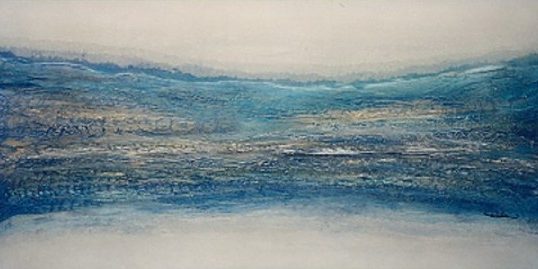
Matsuyama è un pittore di origine giapponese che vive da tempo in Italia. Ha già fornito numerose prove di un suo mondo che insensibilmente si evolve, si rinnova, si apre sempre a nuove sensazioni ed esperienze, rimanendo fondamentalmente fedele a una concezione, come dire, “panica” dell’ambiente. Non affronta il figurativo, ma si scorgono ovunque echi e impronte del naturale, del biologico; l’animato e l’inanimato si richiamano continuamente nel medium di un pulviscolo, a volte policromo, a volte monocromo. Le sue stesure vibrano di un interno continuo fremito vitale.
In quest’atmosfera da moti molecolari browniani entrano, da protagonisti, elementi decisi: una linea, orizzontale o verticale, a volte indicata solo da un diverso svariare del colore, a volte vistosamente segnata da un rilievo, una cresta, un protrudere come in un plastico ove si indica una catena di rilievi montani. Il risultato è una ripartizione che accenna, indica, sottolinea o chiaramente invoca, a seconda del caso, una delle fondamentali caratteristiche del biologico, ma anche dell’inanimato e comunque dell’ordine universale: la simmetria.
In questo ordine, si parla correntemente di “universi paralleli”, di “materia e antimateria”, della “sostanza mancante”. Queste sconvolgenti ipotesi, che hanno implicazioni scientifiche e filosofiche ad un tempo, vengono avvertite da artisti, come Matsuyama, che possiedono antenne sensibilissime.
E in questo ordine domina una costante struttura simmetrica che, nell’attuarsi epifanico, presenta un’imperfezione, una mancanza, un’irregolarità, a configurare una simmetria “asimmetrica”.
Come il volto o il corpo biologico presentano un’indiscutibile simmetria, ma non l’esatta riproduzione speculare delle due parti, così nei quadri di Matsuyama, attento ad echi che provengono da esperienze visive, non riproduce mai specularmente la ripartizione binaria delle sue visioni, ma ne avverte le fondamentali consonanze, con echi musicali, a volte attutiti o distorti o svariati, come in una grande strumentazione musicale.
Nelle ultime opere certe formazioni a losanga allungate fanno pensare o a ferite con grumi di un cupo rosso sanguigno, o a intimità biologiche, o a crepe di un manto minerale che rivela affioranti masse magmatiche scarlatte o dorate. Gli elementi, comunque, binari si dispongono sempre per alludere a una conformazione simmetrica variamente orientata.
Sono già stati segnalati ,da chi si è interessato finora all’opera di Matsuyama, gli echi orientali, gli influssi di quelle filosofie, la specifica adesione alla natura, la commistione di differenti sensibilità, la visiva e la musicale, l’importanza del medium con le sovrapposizioni di specialissime carte per dare ai fondi, il significato di una vibrante texture, come contesto indispensabile al significato complessivo del quadro, e anche gli echi di esperienze che provengono da questa parte del mondo in cui vive.
Tutto questo esiste, e continua ad animare le sue incantate immagini, fatte di luce, di nuances squisite, ma anche di decisi interventi conturbanti e polisemici.
di Domizio Mori
Giugno 1999
SHUHEI MATSUYAMA
Matsuyama s a painter of Japanese origin who has lived in Italy for some time. He has already provided many examples of his world which imperceptibly evolves, renews itself, always open to new sensations and experiences, whilst remaining fundamentally true to a – how can we call it – “panic” conception of the environment. He does not tackle the figurative, but echoes and traces of the natural, the biological can be glimpsed everywhere. The animate and inanimate incessantly recall each other in the medium of dust, at times polychromatic, at times monochrome. His drafts vibrate with an interior, continuous vital thrill.
This atmosphere of Brownian molecular movement sets the stage far the main characters, the decisive elements: a line, horizontal or vertical, at times only indicated by a different variation in color, at times visibly marked by a relief, a crest, a protrusion as in a plastic model to indicate a chain of mountains. The result is a division which hints, indicates, underlines and clearly invokes, depending on the case, one of the fundamental characteristics of the biological, but also of the inanimate, and certainly of the universal order: symmetry.
In this order we currently speak of “parallel universes” of ‘matter and anti-matter, of the “missing substance”. These disturbing hypotheses, which have scientific and philosophical implications at the same time, are noticed by artists, like Matsuyama, who are gifted with extremely sensitive antennas. A constant, symmetrical structure dominates within this order, which, in its revelation fulfillment, has some imperfection, some lack, same irregularity, thus configuring an “asymmetric” symmetry.
Just as the face or the biological body are unarguably symmetric, but never the exact mirror image of the two halves, likewise the paintings of Matsuyama, attentive to the echoes which come from visual experience, never reproduce in mirror form the binary division of his visions, but notice the fundamental consonance, with musical echoes, at times muffled or distorted or varied, Iike a great piece of orchestrated music.
In the later works some elongated lozenge shapes recall either wounds with clots of dark blood red color, or biological intimacy, or cracks in a mineral coating, uncovering scarlet or golden outcrops of magma. The elements, which are in any event binary, are always arranged to provide an allusion to a symmetrical form with various directions.
Those who have shown interest in Matsuyama’s work up to now have painted out oriental echoes, the influences of those same philosophies, a specific adhesion to nature, the medley of different sensitivities, both visual and musical, the importance of the medium with the overlapping of very special paper, to give the backgrounds the overall meaning of the painting, and also the echoes of experiences coming from this ~iar1 of the world where the artist now lives.
All this exists, and continues to provide animation for these enchanted images made of light and exquisite nuances, but also with decisive intervention which is bath disturbing and polysemous.
by Domizio Mori
June 1999