CONVERSAZIONE TRA UN MESSAGGERO, UN MERCANTE ED UN MONACO
Interlocutori: un Messaggero, un Mercante, un Monaco.
Mercante: possiamo cominciare da un punto qualsiasi. lì problema dell’origine del resto non conta. Importa che ci sia un inizio.
Messaggero: forse non ogni punto fomisce un utile accesso. Dato che a me compete la domanda: che cosa ne pensa il nostro ospite e amico?
Monaco: Bandirei ogni cautela se disponessi dell’essenza della cosa, se sapessi dirvela con chiarezza. Eppure occorre pur sempre un indugio, una attesa. Ogni volta mi avvicino a una porta che non mi èconsentito varcare e io me ne sto lì, a far brillare incensi, ad annusame il fumo mentre me ne sto in silenzio.
Messaggero: D’accordo, solo così la nostra povertà assume i caratteri dell’offerta. Ogni costruzione di forme prende origine da un inchino al vuoto, o sbaglio?
Monaco: Non c’è vuoto nè pieno, c’è chi, una forza originaria che li supera e li sorregge.
Mercante: ecco l’inizio, e anche l’origine, evidentemente.
Messaggero: non credo sia cosi agevole. Eppure non sappiamo dire molto di più a riguardo, con le nostre vecchie distinzioni. Che cosa è questa forza, è forma, è contenuto? Se si tratta di impulso vitale, in che relazione sta con la struttura che la accoglie? Come sorge un margine, dove va posta la cornice – tra il dentro e il
fuori, tra il campo del gusto e quello dei nostri comportamenti quotidiani?
Mercante: in omaggio alla tua tradizione, di vecchie domande ne puoi fare quante ne vuoi. Tutte frecce fuori bersaglio. Le cose cambiano in fretta. Anche in base a una certa saggezza marxiana, vediamo dissolversi nell’aria tutto ciò che è solido. Chierici, umanisti e intellettuali organici, non ce n’è uno che ci spieghi come vada a finire.
Monaco: cosi, nello zen, conta piuttosto l’assetto nel tiro che non il bersaglio.
Messaggero: attenendoci a questo spirito usiamo pur sempre, tuttavia, il nostro linguaggio. La prima cosa di cui mi accorgo è un certo fascino del frammento.
Mercante: sì, ma non c’è tutto l’estetismo che già intravedi, manca il ripiego su di sé dell’anima romantica.
Monaco: uso il colore rosso, per esempio, d’inverno. L’azzurro d’estate. Se guardi, dopo un poco di tempo, la luce avrà creato effetti diversi sulla superficie. L’orientamento al sole, la qualità dell’aria e la direzione dello sguardo mutano l’oggetto.
Messaggero: Avventure della percezione. L’ambiente accoglie le singole opere come differenti vibrazioni di uno stesso insieme. L’opera stessa vibra di sue consonanze ogni volta diverse. È la natura del suono con molti significati, Shin on. lì quadro stesso si pone come scrittura ideogrammatica, quasi potessimo pronunciano, per così dire, e non farlo oggetto di contemplazione. La cornice o margine non c’è, è implosa nella zona circostante. Che una musica può aiutare a rendere ospitale. Persiste la nozione di vibrazione. lì quadro – che non è un quadro, ma rinvio a un ambiente, l’esporsi di un mondo – la esemplifica. Ma non c’è relazione di idea a esempio… c’è piuttosto una ripercussione, come nel timpano, per l’orecchio appunto il suono. E non si tratta di una idea, ma è qualcosa di inafferrabile, come l’essenza di leggera palpitazione che viene compressa e liberata nell’haiku.
Monaco: Lavoro mettendo in rilievo una zona centrale o due laterali. Sfumo e diluisco ciò che vi sta intorno, come in un acquerello. lì supporto stesso mi aiuta a variegare la forma, che sia carta di riso o un pannello di ferro arrugginito. Qua e là, a volte, spargo una polvere d’oro.
Messaggero: non si costruisce una cosa, ma si evoca un processo…
Mercante: Sì, ma considera che l’improvvisazione non dà come risultato gli effetti del caso. Pollock e gli altri mimano pur sempre una ricorrente ossessione occidentale. L’alternativa tra caso e fato è una specie di prigione per il sentimento dell’individuo.. .tutte illusioni moderniste, icone vuote… Qui contano le stagioni, l’intervento dell’energia universale, messaggi persino etici il cui senso inaspettato rinnova la dimensione puramente formale.
Messaggero: Per associazione di idee, o di figure, vedo un’alba. Me lo permette un inconscio collettivo. Forse la stessa forza originaria che sta alla
base di questo atto che crea e costruisce. La luce, che giunge a dischiudere i bordi del cielo e della terra, apre una lunghissima linea accesa. Poi pian piano si schiariscono le quinte. A colpi lenti e veloci si aprono chiazze irregolari, aree più o meno smaglianti, fino a che l’alba si compie e rimane una omogenea distesa luminosa su ogni area possibile. Ciò che tuttavia inganna, perchè, a ben vedere, ogni singolo particolare si produce come una piega che porta di nuovo lo sguardo a muoversi.
Monaco: A nutrire il vedere è la meditazione, risultato e insieme stimolo.
Messaggero: Tornando all’haiku, mi pare che ci sia una analoga apparenza di facilità ingannevole. Tre versi. Più che un retorico epigramma, semplici impressioni. Inserto breve e profondo, come una incisione, in un testo immaginario offerto dal sentire e dal percepire.
Monaco: A rinnovare entrambi serve appunto il meditare. Altrimenti si tratta davvero di puro vuoto, inconsolabile lacuna interiore, come forse capita nella dispersione cui i sensi sono il più del tempo indotti.
Mercante: dicevo dei significati etici per indicare questo. Un discorso sull’impiego comune dei sensi.
Messaggero: Ora vedo forme allungate in un torrente congelato. Se guardo meglio, sotto il sottile strato che forma il ghiaccio, ci sono movimenti.
Mercante: Siamo investiti da milioni di immagini ormai senza codice. Chi riabilita l’immaginazione pratica una forma di impegno sociale. Qui poi èl’oriente che ci viene incontro, dandosi a noi con ansia di contaminazione reciproca. A globalizzare anche cose come queste forse ci assillerà dì meno la ruota, comunque repressiva, delle produzioni e dei profitti.
Messaggero: Ciò che più mi colpisce di questa ricerca è l’esattezza con cui si compie. Le impressioni qui non sono oggetto di consumo vago e indefinito. Nella vaghezza si esprime uno dei valori del bello europeo. Qui l’immagine, oltre a coinvolgerci facendosi ambiente, replica fantastica del paesaggio, offerta di dimora, si dà come proposta di misura. Può anche valere come scelta etica, d’accordo, come invenzione di mondi alternativi, ma lo è proprio in quanto risponde a perfetti e segreti canoni, a imprescindibili leggi. Ospitalità che fornisce il limite, anche nel senso di una dimensione minimale. Ma chissà se la mia fantasia corrisponde davvero a una regola, se l’esattezza di cui parlo rientra nel campo d’attrazione di quella forza, primordiale e indefinibile, cui accennavi prima.
Monaco: Lo concedo volentieri. lì colloquio felicemente ci svia dalle nostre strade e ce le fa rivedere come nuove.
Messaggero: Si, ma temo che le mie analogie si vadano facendo sempre più labili.
Mercante: Non occorre che ti giustifichi. Torna sui tuoi passi. È vero, Kurosawa fa entrare i suoi personaggi nei quadri di Van Gogh.
Solo se si propone come elogio della misura e del finito, là in versione fotografica, l’arte ti accoglie come una dimora e non come un naufragio, come invece accade nei nostri infiniti per esempio letterari, leopardiani.
Monaco: Già, e i quadri o le installazioni si devono allo stesso senso del finito, derivano dallo stesso bisogno di completa nettezza.
Messaggero: In questo gioco di rimandi e di riflessioni incrociate ciò che risalta infine è lo scambio della luce. Così avviene tramite le immagini, e in simile modo il colloquio ci ha concesso di venire ospitati e protetti dallo scambio.
Mercante: Beh, in questo rivendico la mia funzione.
Monaco: E noi la riconosciamo.
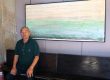
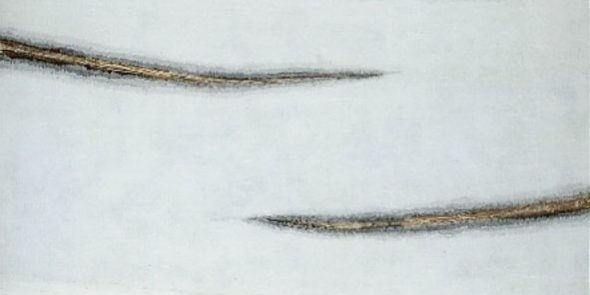
Messaggero: Perciò occorrono più specchi e più punti di vista. La diversità di prospettiva garantisce salute nello sguardo. Non ci rinuncio ma, pur comprendendo il retroterra dei significati, la profondità del segno, soprattutto ripercorro i confini incerti della immagine. Grandi strisce luminose si compongono con necessaria lentezza in un diffuso chiarore. La linea che divideva i due ambiti è divenuta una escrescenza. Essendo generata dallo stucco, presenta un colore grigio fluorescente, ma sembra più che altro imporsi, e rompere come lava di vulcano, nata per fattiva suggestione da acquerelli generosi. Piccola maestà della pietra. Ruggine che si riscopre nobile omamento. Si individuano polveri, scaglie di ulteriore luce preziosa, imprigionate in avverse zone di buio. Altrove la carta di riso impone particolari di raffinata eleganza. Orizzonti velati. Fragili espressioni di gioia.
Monaco: è proprio ciò che intendo.
di Mario Vijiak
Vigliano Biellese, 15 Maggio 1999
CONVERSATION BETWEEN A MESSENGER, A MERCHANT AND A MONK
Characters: a Messenger, a Merchant, a Monk
Merchant: We can start from any point at all. The origin isn’t a problem. The important thing is to have a beginning.
Messenger: Perhaps not every point will provide useful access. Since it’s my business to ask the question: what does our guest and friend think about it?
Monk: I would banish all caution if I knew the essence of the matter. If I could explain it to you clearly. And yet there always has to be some delay, some waiting. Each time I get close to a door I’m not allowed to pass through, there I stand, burning incense and sniffing its odour, waiting in silence.
Messenger: Alright, only this way our poverty looks like an offer. Every, construction of forms has its origin in a bow made to emptiness, am I not right?
Monk: There is no emptiness, no fullness, there is someone, an original force overcoming and supporting them.
Merchant: Here we have the beginning. and also the origin, clearly.
Messenger: I don’t think its that easy.
Yet we don’t have much more to say on the matter, with our old distinctions. What is this force, is it form, is it content? If we’re talking about a vital impulse, how does it relate to the structure which receives it? How does a margin come to be, where do we put the frame – between the inside and the outside. In the realm of taste or in the realm of our daily behaviour?
Merchant: Paying homage to your tradition, you can ask as many old questions as you wish. All arrows off the mark. Things will change quickly. Even using the wisdom of Marx we see everything which is solid dissolve into thin air. Clergymen, humanists and organic intellectual, not one of them is able to tell us how it ends.
Monk: With zen, the way you alm is more important than hitting the mark.
Messenger: If we follow in line this spirit, we are still using our language. The first thing I notice is a certain fascination with fragments.
Merchant: Yes. but then you have just a glimpse of the whole idea of aesthetics: what’s lacking is the retreat into one’s romantic soul.
Monk: For example. I use a red colour for winter. Blue for the summer. If you observe after a short time the light will have created different effects on the surface. The direction of the sun, the quality of the air and the direction you look in change the subject.
Messenger: Adventures in perception. Each work is received by the environment as different vibrations of the same whole. The work itself vibrates with its own harmonies which are different each time. It is the nature of sound with many meanings. Shin- on. The painting itself is placed as ideo-grammatical writing, almost as if we could pronounce it, so to speak, and not consider it as something to be contemplated. The frame or margin isn’t there, but imploded into the surrounding area. A piece of music can help to make it hospitable. The notion of vibration persists. The painting – which isn’t a painting, but the return to an environment, the exposure of a world – exemplifies it. But there is no relation of idea with example.. . rather there is a repercussion, as in the eardrum, sound that is for the ear. And this is not a question of an idea, but something elusive, like the essence of soft palpitation which is compressed and freed in haiku.
Monk: I work by putting a central area or two sides in relief. I blur and dilute the surroundings, as in a watercolour. The support itself helps me to diversity the form. whether it is rice paper or a panel of rusty iron. Here and there I cast some gold dust.
Messenger: You don’t construct a thing. You evoke a process…
Merchant: Indeed, but do consider that improvisation will not give the effects In this case. Pollock and the others are always miming an obsession of the West which repeats itself. The alternative to chance and fate is a kind of prison for the individual’s sentiment.. .all modernistic illusions, empty icons. . .Here it is the seasons which count, the intervention of universal energy, messages which are even ethical, with their unexpected meaning renewing the purely, formal dimension.
Messenger: For association of ideas, or figures. I see a dawn. It is collective unconscious which allows me this. Perhaps the same original force lying at the base of this act which creates and builds. Light, which comes to disclose the edges of heaven and earth, opens an enormous long line of light. Then, slowly, the wings on the stage become clear. Irregular patches open up with slow and fast strokes, areas of varying brightness, until dawn breaks, and a uniform brilliance extends in every possible direction. Which is nevertheless a form of deception because. if you consider things properly, each individual detail is produced as a fold, causing the gaze to move on again.
Monk: Meditation is the food of sight, result and stimulus at the same time.
Messenger: Coming back to haiku, it seems there is a similar appearance of deceptive ease. Three verses. More than a rhetorical epigram, simple impressions. A short, profound insert, like an incision, in an imaginary text offered by, feelings and perceptions.
Monk: Precisely, to renew both you need meditation. Otherwise it is really a case of pure emptiness, an inconsolable blank inside, as happens perhaps in dispersion. to which the senses are induced most of the time.
Merchant: I mentioned ethical significance to indicate this. A discussion on the common use of the senses.
Messenger: Now I see elongated forms in a frozen torrent. If I look more carefully. under the thin layer formed by the ice, there is movement.
Merchant: We are bombarded by millions of images without any codes any more. Someone who rehabilitates his imagination is practising a form of social undertaking. In this case however it is the East coming to us, conceding itself with the fear of reciprocal contamination. Globalising even things like this we will we will perhaps be less troubled by the cycle of production and profit, which is always repressive.
Messenger: What strikes me most about this research is how exactly it is being done. Here impressions aren’t the subject of vague, indefinite consumption. Vagueness is used to express one of the values of beauty.
Merchant: Well, I claim this to be my function.
Monk: And we recognise this.
Messenger: Therefore we need more mirrors and more points of view. Different perspectives are healthy for the sight. I don’t give up but, although I understand the background behind the meanings, the depth of the sign, above all I’m retracing the uncertain boundaries of the image. Big strips of light need time to take shape in diffuse, faint glimmering light. The line dividing the two areas has become an outgrowth. Generated from stucco it has a fluorescent grey light, but more than anything it seems to impose itself, erupting like lava from a volcano, born for effective suggestion from generous watercolours. Small majesty of stone. Rust rediscovered as o noble ornament. Dust and scales of further light can be perceived, imprisoned in hostile dark areas. Elsewhere rice paper imposes details of refined elegance. Veiled horizons. Fragile expressions of joy.
Monk: That’s just what I mean.
by Mario Vijiak
Vìgliano Biellese. l5th May 1999