THE YOMIURI SHIMBUN
“la pittura è paesaggio” ? vibrazione generata dalla fusione dei diversi.
Tendiamo a vedere in ogni figura un paesaggio. Le macchie o i graffi rimasti sul muro, le linee irregolari di una tazza da té, i disegni creati dallo smalto su di essa, ogni cosa ci sembra un paesaggio.
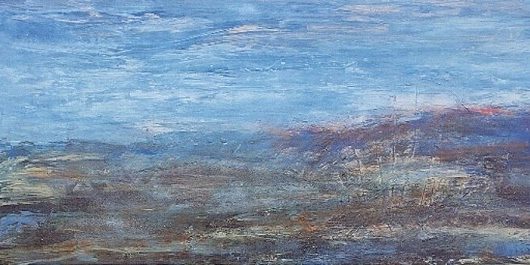
E’, in un certo senso, un vizio dell’uomo. Ma non ci badiamo troppo. Anche qui vedo un paesaggio: un lungo profilo di montagne, altre creste più lontane e sfocate in profondità. In primo piano si estende la superficie delle falde, molto varia e piena di dettagli.
Gli occhi si divertono soddisfatti e la mente si apre con grande libertà. Fin qui è un discorso sul software, ciò che viene suscitato dalle figure. Il resto riguarda l’hardware, ciò che evoca tali visioni.
Quel che ho di fronte a me è in realtà una lastra di ferro. Il color terra che s’estende come la superficie della montagna è una macchia di ruggine. Là dove vedevo il cielo, è coperto con più strati di carta e dipinto in acquarello. Il tatto ruvido della ruggine e la sensazione dei fogli di carta stratificati e irrigiditi, ecco tutta la “sfera tattile” di questa opera.
La lotta di due materiali completamente diversi: ferro e carta. La lotta tra colori che penetrano dallo strato superiore e quelli che emergono dallo strato inferiore. E un’altra lotta tra un fenomeno naturale, la corrosione, e il dipingere che è invece opera umana. In questa opera si avvertono lotte tra discipline diverse in corso contemporaneamente, generando un paesaggio pieno di vibrazioni che suscitano una sensazione di pace straordinaria. Qui, differenti elementi echeggiano tra loro mantenendo la loro diversità. Shuhei Matsuyama riflette: “Questo è ciò che volevo realizzare. Sognavo di esprimere la sinergia tra cose diverse, tra il duro e il soffice, tra l’occidente e l’oriente”.
L’artista ha scelto un unico titolo, “Shin-on”, sotto il quale ha realizzato tutte le sue opere in questi anni. Vive e lavora ormai da 25 anni in Italia, e rivela di essersi finalmente reso conto che il suo obiettivo è di creare l’espressione del “ki” (atmosfera, energia) .
“Nel periodo in cui iniziavo a studiare pittura a Perugia, il mio sguardo si soffermava spesso sulle macchie dei muri mentre camminavo in città. Quelle macchie mi parlavano. Mi domandavo cosa significasse. C’era un’energia che mi parlava. Anche dalle pitture arcaiche incise sulle rocce, diffuse nell’Italia settentrionale, sento emanare lo stesso tipo di energia.
Quanto alla ruggine, di essa si ha solitamente l’immagine di qualcosa di negativo, non voluto, che evoca la fine delle cose. Eppure, di fronte alla prorompente proliferazione del suo color terra, non si può non percepire l’espressione energetica, la sensazione dell’inizio di qualcosa, qualcosa che nasce di fronte a te. Mi auguro che anche le mie opere risultino come una vibrazione simile che scaturisca dal fondo del cuore. Ed è proprio questo il significato di SHIN-ON, che può rappresentare in giapponese diversi concetti di suono, o di vibrazione, a seconda degli ideogrammi da applicarvi: suono del cuore, suono della vibrazione, suono del corpo, suono della verità, e così via. Possono esserci infinite combinazioni di ideogrammi – cioè concetti – da applicarvi, ma forse quello che sto cercando è un universo che inizi d’un colpo dal nulla con un grande slancio di energia (ki).”
Accanto alla creazione artistica, Shuhei Matsuyama si cimenta da anni nella disciplina di karate ed è la cintura nera di quattro dan della scuola Shotokan, maestro che oggi allena i suoi cento allievi a Milano. All’inizio non si rendeva conto dei legami tra le due discipline, la pittura e il karate erano due mondi completamente diversi, lontani, ma dopo anni di allenamento oggi Matsuyama riconosce una certa influenza del karate sulla sua arte. Per esempio, “sun-dome”, il concetto di fermare il colpo appena un istante prima di colpire l’avversario, avrà sicuramente esercitato un’influenza sulla concentrazione energetica nel gesto con cui esegue la sua pittura.
Matsuyama è un personaggio determinato, non esita di fronte all’incertezza, ha sempre scelto di andare avanti deciso. Il suo successo è dovuto anche a questa sua intraprendenza che ha affascinato molte persone in Italia. Ha trovato un ambiente fecondo. Dice al riguardo: “In Giappone si pensa sempre al paragone con gli altri, ma qui è importante che tu sia l’unico, te stesso, punto e basta.” Per lui l’Italia è la terra di persone che cercano di maturare sé stesse col tempo, col lavoro. E’ la terra di persone “positive”.
di Kiyoshi AKUTAGAWA
Traduzione Yosuke TAKI
THE YOMIURI SHIMBUN
“Painting is landscape” – vibration generated by the fusion of various ones.
We tend to see a landscape in every figure. Spots or scratches on a wall, irregular lines in a tea cup created by the enamel on it, each thing looks like a landscape to us. It is, in a certain sense, a vice of man. But we should not pay too much attention to it.
Also here I see a landscape: a long outline of mountains, higher peaks out of focus in the distance. In the foreground, the surface of varied layers full of detail. Our eyes enjoy with satisfaction and the mind opens with great liberty. Up to this point we’re talking about software, that is to say, what is aroused by the figures. The rest has to do with hardware: what is evoked by such visions. The thing that is in front of me is, in reality, a piece of iron. What looks like mountains in earth tones is instead a rust stain. Over there where I see the sky, is an area covered with layers of paper and painted with watercolor. The rough texture of the rust and the sensation of the stratified and hardened paper give a “tactile sphere” to this work.
The battle between two completely different materials: iron and paper. The battle between colors which penetrate from the upper layer and those which emerge from the lower layer. And still another battle between a natural phenomenon, corrosion. and painting which is a human intervention. In this work, you can feel the battle between the various disciplines which exist contemporarily, generating a landscape full of vibrations which give rise to an extraordinary sense of peace. Here, different elements echo among themselves while maintaining their diversity. Shuhei Matsuyama reflects: “This is what I wanted to create. I had a dream of expressing the synergy between different things: between hard and soft, between west and east.” The artist has chosen a single title, “Shin-on”, for all the works he has created in these years. He has lived and worked in Italy for 25 years, and explains he has finally realized that his objective is to create the expression of “ki” (atmosphere, energy):
“In the period when I studied painting in Perugia, my eyes often came to rest on spots on the walls while I walked through the city. Those spots spoke to me. I wondered what it meant. It was an energy that was speaking to me. I feel the same type of energy emanating from ancient incised designs in rocks found in northern Italy. As for the rust, usually we have the idea of something negative, undesired, which signals the end of things. However, faced with such an irrepressible proliferation of its earth tones, it’s not possible to not perceive the energy, the sensation of something’s beginning, something which is being born in front of your eyes. I hope that also my works vibrate in a similar way, welling up from within the heart. This is in fact the meaning of SHIN-ON. In Japanese it can mean various concepts of sound or vibration, depending on the ideograms used: the sound of the heart, the sound of vibration, the sound of the body, the sound of truth, and so on. There can be infinite combinations of ideograms – in other words, concepts – but perhaps the thing I’m searching for is a universe which begins with one blow from nothing with a great rush of energy (ki)”.
Along side his artistic creation, Shuhei Matsuyama has been involved for years in karate and is a fourth dan black belt in the Shotokan school; he is a master and trains a hundred students in Milan. At the beginning, he wasn’t aware of the bond between the two disciplines. Painting and karate were two completely different, distant worlds, but after years of training, today Matsuyama recognizes a certain influence of karate in his art. For example, “sun-dome”, the concept of stopping a blow just before striking the adversary surely has exerted influence on the energetic concentration of movement with which he executes his painting.
Matsuyama has determination and does not hesitate in the face of uncertainty and he has always chosen to move forward. His success is also due to this boldness which has fascinated many people in Italy. He has found a fertile environment and he says, “In Japan, one always makes comparisons with others, but here it is important to be unique, yourself, and that’s all.” For him, Italy is the land of people who try and mature with time, and with work. It is the land of “positive” people.
by Kiyoshi AKUTAGAWA
Translate by Yosuke TAKI